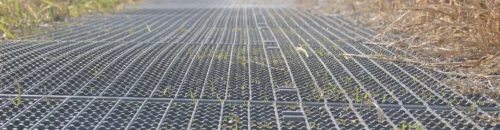
How Much Does Steel Grating Weigh? Steel Grating Weight per Square Metre by Bar Size and Pitch
A rejilla de acero panel’s weight comes down to three numbers: bearing bar size, bar pitch, and cross bar size. Get those right, and you can predict the steel grating weight per square metre before anyone quotes you.
Start with the smallest common bar — 25 × 3 mm at 30 mm pitch. That panel runs about 19.6 kg per square metre before cross bars and zinc. Swap in a 50 × 6 mm bar at the same pitch and it climbs to 78.5 kg. Same footprint, four times the steel.
That gap explains most quotation surprises. Two panels look identical in a photo and still differ by 300% in steel content.
What Determines the Weight of a Steel Grating Panel
Four variables decide the number, and only four.
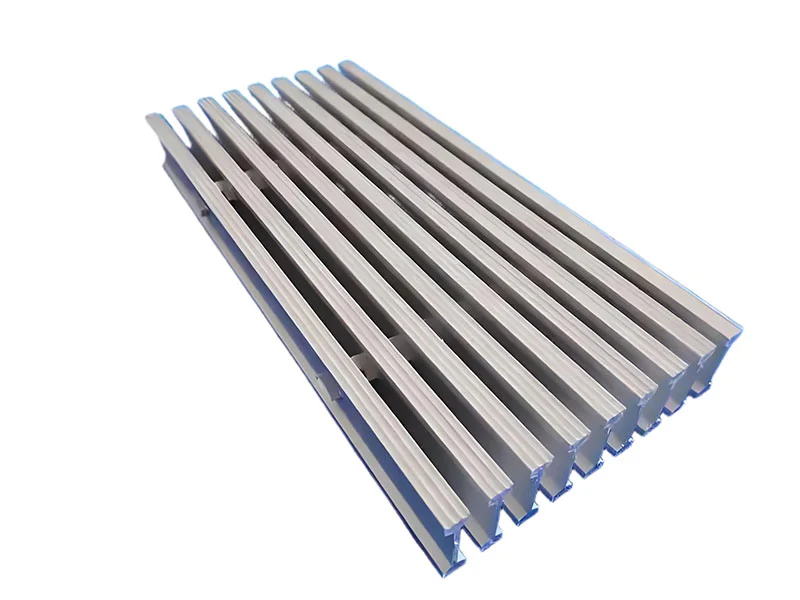
The first is bearing bar depth and thickness. A 25 × 3 mm bar carries 75 mm² of steel section. A 60 × 8 mm bar carries 480 mm² — 6.4 times as much, in the same panel size.
The second is bearing bar pitch, the centre-to-centre distance between bars. At 30 mm pitch you fit 33 bars in a metre of width. At 100 mm pitch you fit 10. Halve the pitch, roughly double the steel.
The third is the cross bar. Six, eight, or ten millimetre square bar, set at 50 or 100 mm centres, typically adds 3–15% on top of the bearing bar weight.
The fourth is steel grade, and it barely matters. Carbon steel Q235B and stainless 304 differ by about 1% in density, so grade changes cost, not weight.
Steel Grating Weight per Square Metre by Bar Size
The table covers the six bar sizes that account for most orders, starting from a steel grating raw panel before any cutting or finishing.
| Bearing bar (mm) | 30 mm pitch | 40 mm pitch | 60 mm pitch | 100 mm pitch |
|---|---|---|---|---|
| 25 × 3 | 19.6 | 14.7 | 9.8 | 5.9 |
| 30 × 4 | 31.4 | 23.6 | 15.7 | 9.4 |
| 32 × 5 | 41.9 | 31.4 | 20.9 | 12.6 |
| 40 × 5 | 52.3 | 39.3 | 26.2 | 15.7 |
| 50 × 6 | 78.5 | 58.9 | 39.3 | 23.6 |
| 60 × 8 | 125.6 | 94.2 | 62.8 | 37.7 |
All figures are kilograms per square metre, based on a steel density of 7.85 g/cm³. They exclude cross bars and surface coating.
Add 3–15% for cross bars. Light panels sit near the top of that range because a fixed cross bar weighs the same regardless of bearing bar size. For rejilla de acero de alta resistencia with 6 mm cross bars at 100 mm centres, the allowance drops to about 3%.
How to Calculate It Yourself
You do not need a catalogue to check these numbers. Two steps do it.
First, work out the weight of one bearing bar per metre:
thickness (mm) × depth (mm) × 7.85 ÷ 1000 = kg per metre of bar
A 32 × 5 mm bar gives 5 × 32 × 7.85 ÷ 1000 = 1.256 kg per metre.
Second, divide by the pitch in metres. At 60 mm pitch that is 1.256 ÷ 0.06 = 20.9 kg per square metre.
From there, add the cross bars and the zinc. Hot-dip galvanizing to ISO 1461 adds roughly 0.5–1.0 kg per square metre at a 70 µm coating. For a sanity check across materials, compare this figure with aluminium grating of the same bar size, which comes out at about a third of the steel number.
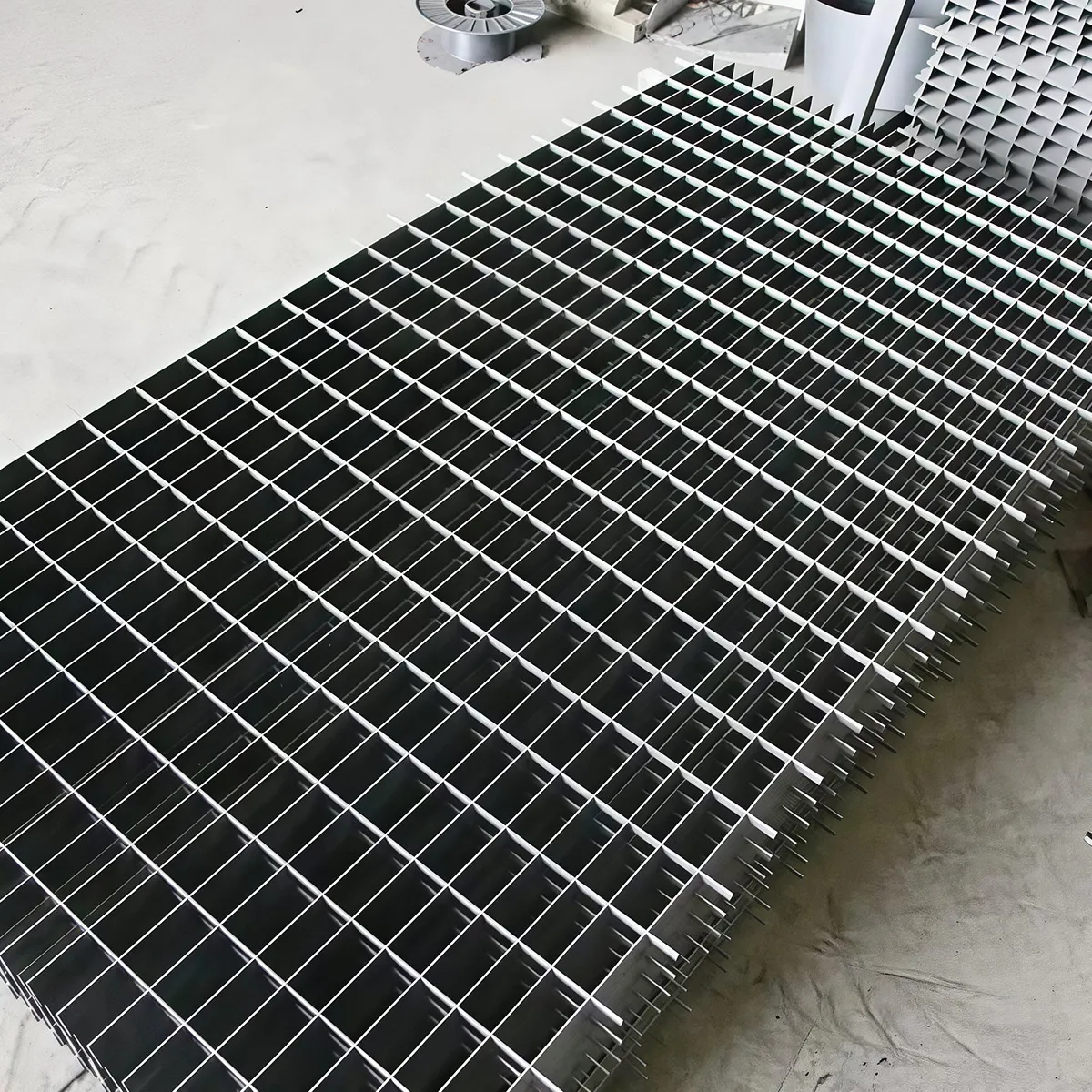
Why the Weight Number Matters
Weight drives money in four places, and each one bites differently.
Lifting comes first. A 1 × 6 m panel of 40 × 5 at 30 mm pitch weighs around 314 kg. Two workers cannot handle that by hand, so the lifting plan changes before the panel leaves the truck.
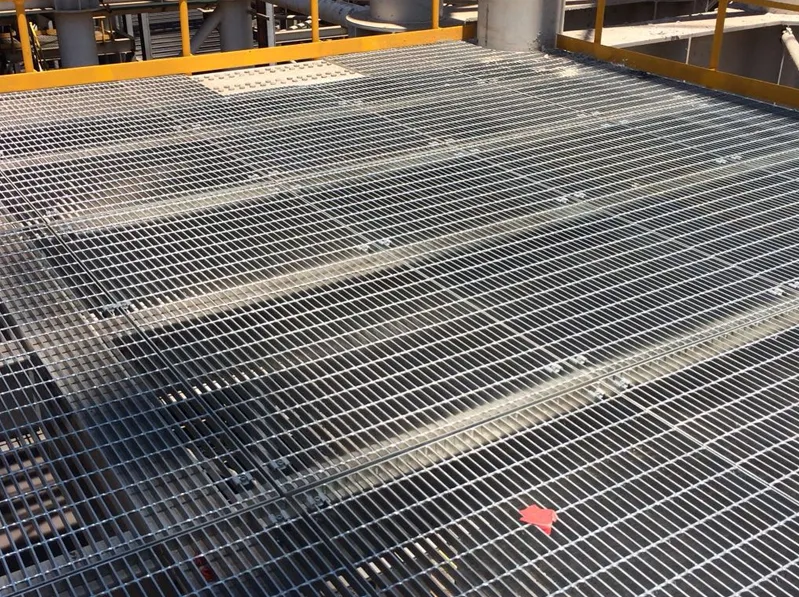
Structural dead load comes second. On a pasarela de rejilla de acero, the grating adds permanent load that the support frame must carry. Engineers want that figure early, not after the steel is cut.
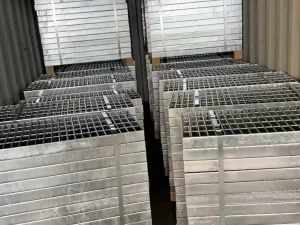
Ocean freight comes third. Grating is dense, so chargeable weight normally follows actual weight rather than volume. A heavier specification can push a container from full to over limit.
Packing comes last. Heavier panels mean fewer pieces per crate and a lower stack. That changes loading time and damage risk on arrival.
Coating barely moves any of this. Choosing galvanized steel grating over mill finish adds 0.5–1.0 kg per square metre, which is noise next to a bar size change.
Preguntas frecuentes
Usually three reasons: the cross bars, the galvanizing, and bar thickness tolerance. Hot-rolled strip often measures slightly under nominal, so a 3 mm bar may arrive at 2.9 mm. Always ask whether a quoted weight is theoretical or actual.
About 0.5–1.0 kg per square metre for a standard 70 µm coating. Thicker coatings for severe corrosion add more, but never enough to justify changing bar size.
Almost the same. Both use the same bars and pitch, so the steel content matches closely. Press-locked steel grating saves labour and distortion, not weight.
Slightly. Grade 304 has a density of 7.93 g/cm³ against 7.85 for carbon steel, so expect around 1% more. Choose stainless for corrosion resistance, never for weight.
Need the actual weight for a specific panel size? Send the bar size, pitch, cross bar, and panel dimensions, and we will return the figure with the calculation shown.
About the author — Nicholas
Nicholas has worked on the commercial and technical side of steel grating supply for 10 years, based in Wuxi, Jiangsu. His daily work runs between a buyer’s drawing and a production sheet: reviewing specifications, quoting, arranging third-party inspection and checking container loading. He writes about what actually decides whether a grating order passes inspection — bearing bar size, cross bar pitch, load class, and galvanizing to YB/T 4001.1, ANSI/NAAMM MBG531 or BS 4592. Contact: nicholas@sino-grate.com