China Metal Grating Bar: Complete Buying Guide for Importers 2026
Ottobre 15, 2026
Blog
If you’re sourcing metal grating bars for industrial projects, choosing the right Chinese supplier can cut your material costs by 30 to 50 percent compared to local European or North American manufacturers. But the gap between a smooth import experience and a logistical headache often comes down to one thing: knowing exactly what to ask for before you place that first order.
This guide walks you through everything importers need to know about China metal grating bar products — from core specifications and manufacturing standards to supplier vetting, pricing, and common pitfalls to avoid. By the end, you’ll have a practical checklist to take into your next supplier conversation.
What Is a Metal Grating Bar?
Metal grating bars are the load-bearing longitudinal components that form the base structure of griglia in acciaio panels. They run parallel to each other, spaced at fixed intervals, and are welded or locked to transverse cross rods (twisted square bars or flat bars) that hold the whole grid together.
While buyers often search for “metal grating sheet” as the finished product, the quality of the individual grating bars underneath determines everything that matters in the end product: load capacity, deflection resistance, corrosion performance, and service life.
Common materials used for metal grating bars from Chinese mills include:
- Mild steel (low-carbon steel): The most widely used option, typically S235JR or Q235 grade, known for good weldability and cost efficiency. When hot-dip galvanised, this becomes what the UK and Australian markets call galvanised mild steel grating — a workhorse choice for drainage covers, walkways, and platform flooring.
- Acciaio inossidabile: Grades 304 and 316 offer superior corrosion resistance for coastal, chemical, and food-processing environments.
- Aluminium: Lightweight, non-sparking, and naturally corrosion-resistant, popular for architectural and offshore applications.
Key Specifications to Confirm Before Ordering China Metal Grating Bar Products
One of the most common reasons importers receive the wrong shipment is vague specification sheets. Chinese manufacturers are highly flexible, but they can only produce what you clearly specify. Here are the non-negotiable parameters to lock in.
Bar Cross-Section and Dimensions
Grating bars come in three primary profiles:
- Flat bars: Rectangular cross-section, the standard choice for most industrial grating. Typical sizes range from 20×3 mm up to 75×10 mm.
- Twisted square bars: Used as cross-connectors rather than main load-bearing bars, usually 6×6 mm, 8×8 mm, or 10×10 mm.
- I-bar / T-bar: Wider at the top and narrower at the bottom, offering higher strength-to-weight ratio for heavy-duty applications.
The depth of the bar (the vertical dimension) directly determines load-bearing capacity. A 30 mm deep bar handles pedestrian traffic; a 75 mm deep bar is required for forklift and truck traffic on heavy-duty platforms.
Center-to-Center Spacing
Standard bar spacing in China follows either metric or imperial conventions:
- Metric standard: 30 mm × 100 mm spacing (main bars every 30 mm, cross rods every 100 mm) is the most common for general-purpose galvanised mild steel grating.
- Imperial standard: 3/4 inch × 3/16 inch or 19×60 mm equivalents, common for projects referencing American or British standards.
Narrower spacing (down to 15 mm) is available for anti-slip or small-part fall-through protection. Wider spacing (up to 40 mm) reduces cost for non-critical areas.
Surface Treatment
This is where many first-time importers make mistakes. “Galvanized” means different things to different factories:
- Pre-galvanised: The steel strip is galvanised before being processed into grating. Cheaper, but weld points are unprotected. Expect a 5 to 10 year service life in mild environments.
- Hot-dip galvanised after fabrication: The fully welded grating panel is dipped as a whole. All welds and cut edges are coated. This is the standard for galvanized steel grating cover products used in drainage, sewage, and external walkways — expect 20 to 30 years of service in normal outdoor conditions.
- Black / untreated: Bare steel, only suitable if you plan to paint on-site or use indoors.
Always specify “hot-dip galvanised after welding” and request the zinc coating thickness (minimum 55 μm for outdoor use, per ISO 1461).
Manufacturing Methods: What Differences Matter in Practice
Chinese factories produce metal grating bars using two main processes. The method affects both price and performance.
Welded Grating Bars
Resistance-welded grating fuses the intersection of main bars and cross rods under high pressure and current. It’s the most common and cost-effective option, accounting for roughly 70 percent of China metal grating sheet exports. Welded grating works well for standard loads and uniform distribution.
Press-Locked / Swage Grating
Press-locked grating mechanically locks cross rods into pre-punched holes in the main bars using hydraulic presses. It offers a cleaner appearance and stronger joint integrity under point loads. This is the preferred method for architectural grating, stair treads, and areas with heavy dynamic loading.
When comparing quotes, ask explicitly which process the factory uses — a welded quote will always be lower, but press-locked may be worth the premium for high-visibility or safety-critical projects.

Quality Standards: Which One Should You Reference?
Chinese manufacturers can produce to multiple national standards, but not every factory has the quality control systems to actually meet them. The most common standards for export grating are:
- BS 4592-1: British standard for industrial floor and stair tread grating. Widely specified in the UK, Middle East, and Southeast Asia.
- ASTM A1011 / A36: American standard for steel bar material. Common for North American projects.
- GB/T 13788: Chinese national standard. The baseline that all domestic production follows — acceptable for low-spec projects but may not meet stricter Western requirements.
Ask potential suppliers which standard they routinely produce to, and request mill test certificates (MTCs) for the steel coils used to make your grating bars. Reputable factories will provide these without hesitation.
How to Vet a China Metal Grating Bar Supplier
Not every factory on Alibaba or Made-in-China is a true manufacturer. Trading companies often appear in search results and may quote slightly lower prices, but they add a layer of communication risk and reduce your leverage on quality disputes. Here’s how to separate real manufacturers from middlemen.
Check Their Production Capacity
Ask for:
- Daily output in square meters
- Number of welding machines or press-locked lines
- Whether they have their own hot-dip galvanising line or outsource this step
Factories with in-house galvanising offer shorter lead times and better coating consistency. If galvanising is outsourced, build an extra 7 to 10 days into your delivery timeline.
Request Sample Panels First
Before committing to a full container order, always order a 300×300 mm or 500×500 mm sample panel. Check:
- Bar straightness and flatness
- Weld quality (no cold welds, no spatter)
- Zinc coating uniformity (no bare spots at edges)
- Dimensional accuracy (measure bar spacing with a caliper)
Sample cost is usually recoverable from your bulk order, and it’s the single best way to prevent a container of non-conforming product.
Evaluate Their Export Experience
Ask how many years they’ve been exporting, and to which countries. A factory that regularly supplies to Germany or Australia will be more familiar with strict documentation, packaging, and inspection requirements than one that only sells domestically.
Pricing Structure: What Drives the Cost of China Metal Grating Bar?
Metal grating pricing is primarily calculated per square meter, but several variables move the price up or down significantly. Understanding these helps you compare quotes accurately.
The base price depends on:
- Raw material cost: Mild steel prices fluctuate with domestic Chinese rebar and coil markets. Galvanised mild steel grating typically costs 15 to 25 percent more than black steel grating due to the zinc coating.
- Bar profile and depth: Deeper bars and thicker cross-sections use more steel, directly increasing cost. Heavy-duty 75 mm deep grating can cost twice as much as standard 30 mm pedestrian grating.
- Spacing density: Closer bar spacing means more bars per square meter = higher price.
- Surface finish: Hot-dip galvanising adds roughly $15 to $25 per square meter to the base material cost. Stainless 316 grating is typically 4 to 5 times the price of galvanised mild steel grating.
- Order quantity: Full container loads (usually 200 to 300 square meters per 20ft container) bring the per-square-meter price down substantially compared to LCL shipments.
As a rough benchmark, standard 30×3 mm hot-dip galvanised welded grating FOB Shanghai typically ranges from $35 to $55 per square meter in 2026, depending on order volume and specification complexity. Always request FOB pricing first, then ask for CIF to your destination port for a complete landed cost comparison.
Common Applications and Use Cases
China metal grating bar products serve a wide range of industries. Knowing the typical application helps you specify the right grade:
- Drainage and trench covers: Galvanized steel grating cover solutions are widely used in municipal drainage, airport perimeter drainage, and industrial floor trenches. Standard 30×3 mm welded grating handles pedestrian and light vehicle traffic.
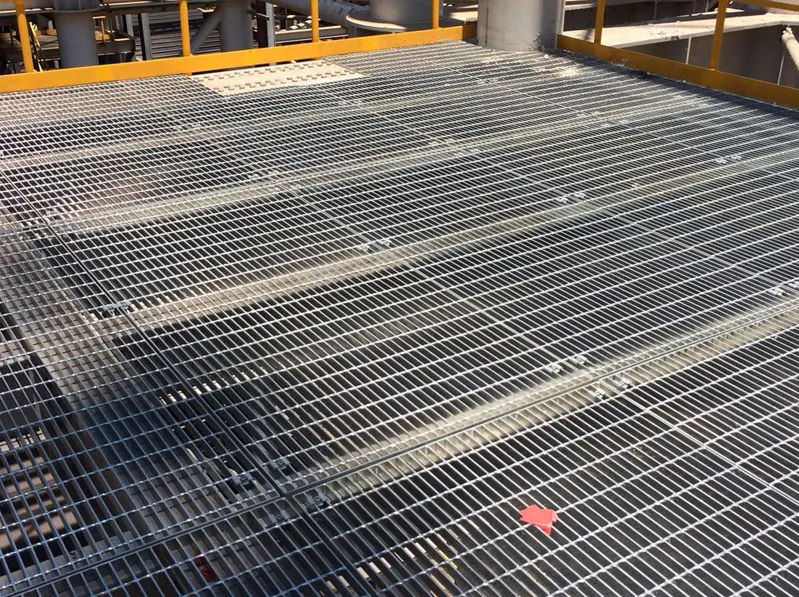
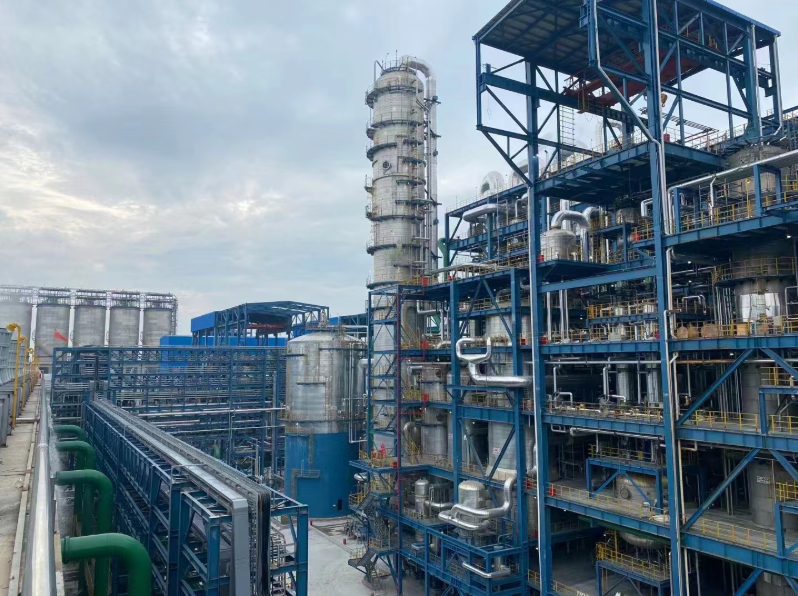
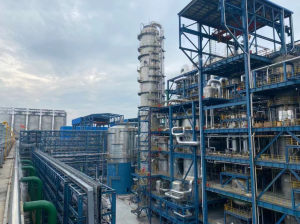
- Industrial platforms and walkways: Steel mills, power plants, and refineries use galvanised mild steel grating for access platforms. Expect 40 to 50 mm bar depth for worker walkways, and 75 mm for equipment maintenance platforms.
- Stair treads: Non-slip serrated grating bars are commonly specified for outdoor stairs in wet or icy climates.
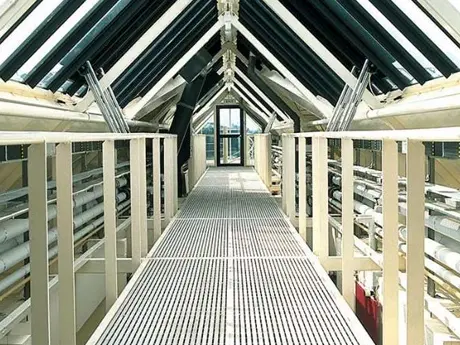
- Flooring and fencing: Compound grating (steel grating bonded to a checkered steel plate on top) provides a solid walking surface while maintaining drainage below.
Import Logistics: Lead Times, Packaging, and Customs
Plan your project timeline realistically. From order confirmation to arrival at your warehouse, the typical timeline is:
- Production: 15 to 25 working days for a standard container order
- Galvanising: Additional 5 to 7 days if outsourced
- Ocean freight: 25 to 35 days to Western US, 30 to 35 days to Northern Europe, 18 to 25 days to Southeast Asia
- Customs clearance and inland transport: 5 to 10 days
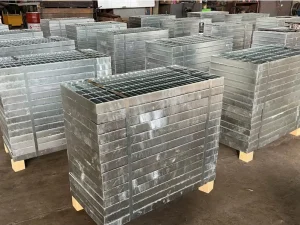
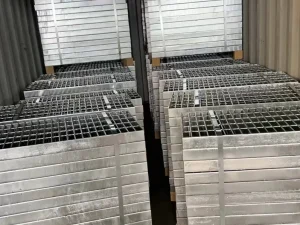
Packaging matters too. Metal grating panels should be strapped on steel pallets, with edge protection to prevent galvanising damage during loading and unloading. Loose panels stacked without strapping almost always arrive bent or scuffed.
Frequently Asked Questions
What is the minimum order quantity for China metal grating bar products?
Most manufacturers set MOQs around 50 to 100 square meters for standard sizes. Custom sizes or non-standard materials may require higher MOQs. For trial orders, ask if the factory supports mixed-container shipments with other products.
Can I get custom-cut sizes?
Yes. Chinese factories cut grating to your required panel dimensions, typically with ±5 mm tolerance. Stair treads can be pre-fabricated with nosing plates and anti-slip serrations.
How do I handle quality disputes?
Insist on pre-shipment inspection (PSI) by a third-party agency like SGS or Bureau Veritas before the container leaves China. The cost (usually $200 to $300 per inspection) is negligible compared to the cost of receiving a non-conforming container.
Conclusion: Sourcing China Metal Grating Bar Successfully
The advantage of sourcing metal grating bars from China isn’t just lower price — it’s the combination of mature manufacturing capacity, flexible customization, and competitive pricing that makes it attractive for projects of all sizes. The key to a successful import lies in rigorous specification, sample verification, and choosing a manufacturer with real export experience rather than a trading company that adds no value.
Start with a clear specification sheet that defines bar profile, spacing, material grade, surface treatment, and applicable standards. Order samples. Compare at least three suppliers on both price and technical responsiveness. And build a working relationship — the best Chinese suppliers become long-term partners that help you refine designs and solve on-site problems over time.
If you’re ready to request a quote or discuss a specific project specification, contact Sino Grating today with your drawings or requirements. Our engineering team can help you select the right metal grating bar configuration for your application, whether you need standard galvanised mild steel grating for a drainage project or custom press-locked panels for an architectural facade.