What Makes Galvanised Mild Steel grating the Go-To Choice?
10月 15, 2026
ブログ
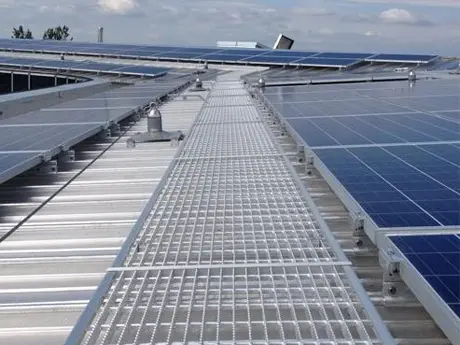
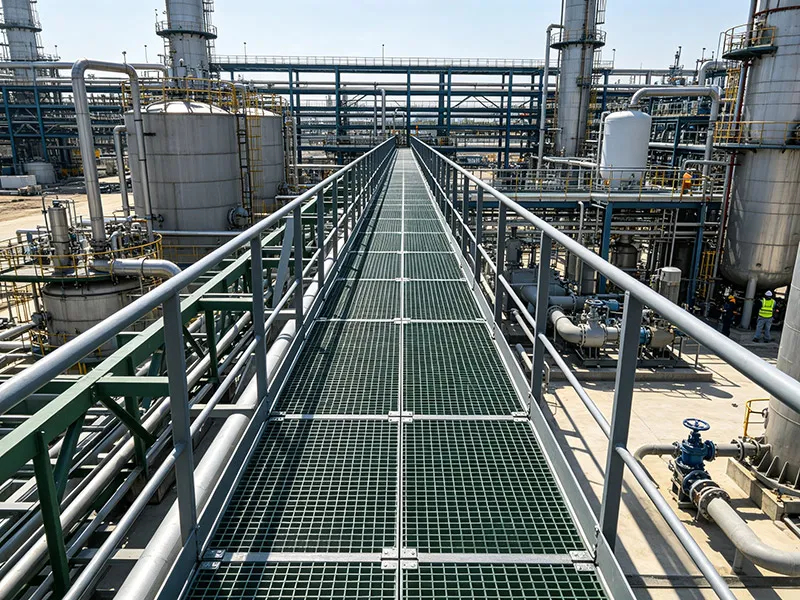
Walk onto any industrial platform in Europe, Australia, the Middle East, or Southeast Asia, and you’re almost certainly standing on galvanised mild スチールグレーチング. It’s the default flooring choice for refineries, chemical plants, water treatment facilities, food processing plants, and municipal infrastructure — and for good reason.
But why has this combination of materials become the industry standard, when alternatives like stainless steel, aluminium, FRP, and solid steel plate all have their own advantages? The answer lies in a unique balance of properties that no other material matches for the vast majority of applications.
This guide breaks down exactly what makes galvanised mild steel grating the go-to choice — the material science, the practical performance, and the economic logic that have made it the world’s most widely specified grating product.
The Material Behind the Product
To understand its dominance, it helps to understand the two components that come together.
Mild steel is the most common and cost-effective structural steel on the planet. With low carbon content (typically 0.05–0.25 percent), it’s ductile, easy to weld, readily available, and comparatively cheap. It’s the material of choice for everything from structural beams to automotive bodies. Its one weakness is that it rusts when exposed to moisture.
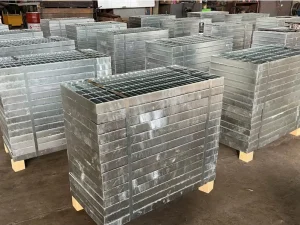
Hot-dip galvanising solves that weakness. After the china metal grating bar elements are welded or press-locked into panels, the finished product is dipped in a bath of molten zinc at roughly 450°C. The zinc reacts metallurgically with the steel surface, forming a series of zinc-iron alloy layers that become an integral part of the material — not just a coating sitting on top.
The result is galvanised mild steel grating: a product that combines the structural strength and workability of mild steel with decades of corrosion protection from the zinc layer.
Reason 1: The Best Balance of Strength and Cost
There are stronger materials and more corrosion-resistant materials, but nothing combines structural performance and price the way galvanised mild steel does.
Consider the alternatives:
- ステンレス鋼 has better corrosion resistance but costs 4 to 5 times more. For applications where galvanised steel already lasts 25 years, the stainless premium isn’t justified.
- Aluminium is lighter and naturally corrosion-resistant, but costs 2.5 to 3 times more and has lower structural strength — you need deeper profiles to match steel’s load capacity, erasing the weight advantage.
- FRP (fibreglass) is non-corrosive and lightweight, but degrades under UV exposure, has lower load capacity, and typically needs replacement within 10 to 15 years.
- Cast iron is extremely strong but heavy, expensive, and prone to cracking under impact.
Galvanised mild steel sits in the sweet spot: strong enough for almost all industrial loads, corrosion-resistant enough for most outdoor environments, and at a price point that makes it economically viable for large-scale projects.
This cost-performance balance is the single biggest reason it’s the go-to choice — engineers don’t have to compromise on either performance or budget.
Reason 2: Decades of Maintenance-Free Service
In industrial and infrastructure projects, maintenance is a major cost. Any flooring or structural element that needs regular repainting, coating, or inspection adds up over time.
Galvanised mild steel grating eliminates that ongoing cost. The zinc coating:
- Lasts 20 to 30 years in typical outdoor atmospheric conditions
- Requires no painting, sealing, or protective treatment
- Self-heals small scratches through cathodic protection (zinc corrodes before steel, protecting exposed areas)
- Maintains its appearance and structural performance year after year
Compare this to painted steel grating, which needs repainting every 3 to 5 years — involving scaffolding, labour, and often production shutdowns. Over a 25-year project lifecycle, that’s three to four repainting cycles that galvanised owners never have to budget for.
When you calculate the total cost of ownership per year of service, galvanised grating is almost always the cheapest option — even when the upfront purchase price is slightly higher than alternatives.
Reason 3: Proven, Predictable Performance
Engineers trust materials they understand. Mild steel has been used in construction for over a century, and its mechanical properties — yield strength, tensile strength, modulus of elasticity — are well characterised and documented.
This means when an engineer specifies galvanised mild steel grating for a platform or walkway, the load calculations are reliable. Deflection under load, factor of safety, and load ratings can all be calculated accurately because the material properties are known quantities.
Hot-dip galvanising is also a mature, standardized process. Standards like ISO 1461, ASTM A123, and AS/NZS 4680 specify minimum coating thickness, finish quality, and testing methods. Chinese manufacturers who export internationally produce to these standards, and buyers can specify exactly what they expect.
This predictability matters: when you design with galvanised steel, you know exactly what you’re getting. No surprises about material consistency, no performance uncertainty.
Reason 4: Versatility Across Applications
Galvanised mild steel grating works across an enormous range of applications. The same material that builds a refinery walkway also builds:
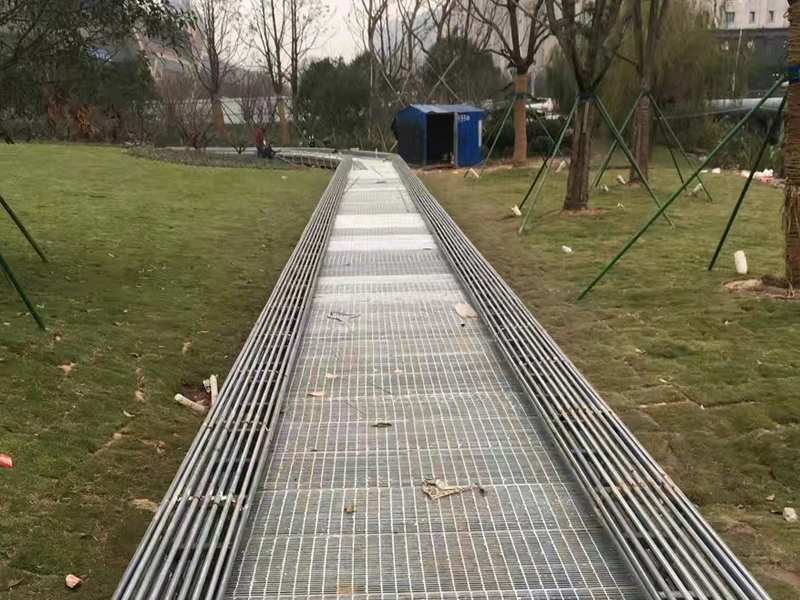
- Drainage covers and trench gratings for roads and factories, including standard galvanized steel grating cover panels with reinforced frames
- Stair treads for industrial and commercial buildings
- Bridge sidewalks and pedestrian walkways
- Machine guards and safety barriers
- Agricultural flooring and livestock facilities
- Mezzanine platforms in warehouses
- Fencing infill panels
This versatility is possible because the material can be configured in different ways — different bar depths, spacings, surface treatments, and frame details — to match each application’s specific requirements.
One material family covers pedestrian walkways, vehicle-rated covers, and architectural screens. That flexibility means specifiers don’t have to learn a new material system for every project.
Reason 5: Safety Built In
Industrial flooring has to be safe. Galvanised mild steel grating delivers safety on multiple fronts:
Non-slip surface: Water drains through the open grid immediately, leaving the walking surface dry. No standing water means no slippery patches. For extra grip, serrated bar profiles provide aggressive traction even in wet or oily conditions.
Non-combustible: Steel doesn’t burn, doesn’t emit toxic fumes, and doesn’t lose structural integrity in a fire. This is why galvanised grating is the standard choice for fire escape routes and industrial facilities with strict fire codes.
Visible through the grid: The open pattern allows workers on lower levels to see hazards above, and vice versa. This improves situational awareness in industrial environments.
No sharp edges: Properly fabricated panels have finished edges, frames, and nosings — not the raw cut ends of unprocessed grating.
Reason 6: Supply Chain Maturity
Beyond material properties, the global supply chain for galvanised mild steel grating is exceptionally well developed. Chinese manufacturers have spent decades refining production, and the result is:
- Consistent quality across production runs
- Short lead times for standard sizes
- Competitive pricing from mature production processes
- Easy access to replacement panels and custom modifications
- Established export logistics to every major market
When you specify galvanised grating, you’re not betting on a niche product with limited suppliers. You’re choosing a material with a global supply base, which means you can source it reliably for projects anywhere in the world.
Where It’s Not the Best Choice
For completeness, it’s worth noting where galvanised mild steel grating has limitations:
- Continuous water immersion: Permanently submerged environments wear through zinc faster. For underwater or constantly submerged applications, stainless steel or coated alternatives are better.
- Strong chemical exposure: Facilities handling concentrated acids, alkalis, or corrosive chemicals will see accelerated zinc degradation. 316 stainless steel is the upgrade here.
- Coastal / marine splash zones: Salt spray accelerates corrosion. While galvanised works in coastal areas, 316 stainless offers longer service life in salt-heavy environments.
- Direct food contact: Where food touches the grating surface, stainless 304/316 is required for hygiene.
- Architectural showcase locations: The spangled, matte galvanised finish isn’t considered aesthetic for building facades or premium public spaces.
In these niche applications, other materials make more sense. But for the vast majority of industrial, infrastructure, and drainage applications, galvanised mild steel grating remains the optimal choice.
Why Chinese-Made Galvanised Grating Leads the World
The final piece of the puzzle is why so much of the world’s galvanised grating comes from China. It’s not just about cheap labour — it’s about a complete manufacturing ecosystem:
- Raw material proximity: China produces half the world’s steel, so grating fabricators have direct access to affordable coil and flat bar.
- Mature production clusters: Regions like Hebei and Jiangsu have developed specialised manufacturing ecosystems, from raw steel processing to galvanising and export.
- Quality evolution: Chinese manufacturers have moved beyond commodity production, now meeting international standards with consistent quality control.
- Export experience: Decades of shipping to Europe, Australia, the Middle East, and Southeast Asia have built the documentation, packaging, and logistics know-how that international buyers require.
The result is that buyers worldwide can specify china metal grating sheet products to exact international standards, delivered to their port at competitive prices — a supply chain maturity that took decades to build.
結論
Galvanised mild steel grating is the go-to choice for a simple reason: it hits the exact performance-cost sweet spot that most applications demand. It’s strong enough for industrial loads, corrosion-resistant enough for decades of outdoor service, safe to walk on, and affordable enough for large-scale projects. No other material matches this combination across the full range of industrial, infrastructure, and drainage applications.
For engineers, specifiers, and procurement teams, it’s the default answer — and for good reason.
To discuss your specific galvanised grating requirements or request samples and quotations, contact Sino Grating today. Our team produces galvanised mild steel grating to international standards, with full traceability and export support for projects worldwide.