How Resistance-Welded Grating Is Manufactured: Unique Electro-Forge Welding Technology
The superior performance of resistance-welded grating originates from its standardized, precision-controlled electro-forge resistance welding process, a professional manufacturing technology exclusive to high-grade industrial grating production. Understanding this process helps buyers distinguish genuine resistance-welded grating from ordinary welded grating products and avoid low-quality substitutes.
First, high-quality carbon steel or stainless steel raw materials undergo strict inspection and preprocessing. Steel bars are straightened, precision-cut, and sized to eliminate dimensional errors and surface defects, ensuring consistent panel flatness and structural uniformity. Qualified bearing bars and cross bars are then automatically arranged at fixed intervals by professional grating production equipment to form a standard grid layout.
The core manufacturing step is electro-forge resistance welding. High current passes through the contact points of bearing bars and cross bars, generating intense instantaneous resistance heat that melts the steel contact surfaces. Synchronized hydraulic pressure presses the molten bar intersections tightly together, completing metallurgical fusion in milliseconds. This filler-free welding method creates extremely high-strength welding joints that will not loosen, deform, or fall off under long-term vibration and heavy loads.
After welding molding, all resistance-welded grating panels are deburred and polished to remove sharp edges for safe installation and use. Finally, customized surface treatments including hot-dip galvanizing, electro-galvanizing, and stainless steel passivation are applied to enhance corrosion resistance. Finished products undergo strict load testing, flatness inspection, and welding quality detection before packaging and delivery, ensuring full compliance with industrial engineering standards.
Main Types of Resistance-Welded Grating for Industrial Use
Resistance-welded grating is categorized by material composition, surface design, and load-bearing capacity, with four mainstream types covering almost all industrial and municipal engineering scenarios. Each type has targeted performance characteristics and applicable environments for precise project matching.
1. Hot-Dip Galvanized Resistance-Welded Grating
As the most cost-effective and widely used type, hot-dip galvanized resistance-welded grating features a complete zinc coating formed by high-temperature galvanizing treatment. The dense zinc layer isolates the steel substrate from air, moisture, and corrosive substances, providing excellent rust and oxidation resistance. This type of grating is lightweight, easy to install, and low-maintenance, perfectly suitable for conventional industrial workshops, municipal drainage systems, general factory platforms, and indoor and outdoor walkways. For most conventional B2B projects, galvanized resistance-welded grating offers the best balance of performance and budget.
2. Stainless Steel Resistance-Welded Grating
Made of 304 or 316 marine-grade stainless steel, stainless steel resistance-welded grating abandons galvanized surface treatment and relies on the inherent properties of stainless steel to achieve corrosion resistance, high-temperature resistance, and acid-base resistance. It features a smooth, non-porous surface that is easy to clean and sterilize, with zero rust risk even in humid, corrosive, and high-salinity environments. It is widely applied in food processing factories, pharmaceutical workshops, chemical plants, offshore platforms, and coastal port projects where high hygiene and anti-corrosion standards are required.
3. Serrated Anti-Slip Resistance-Welded Grating
Serrated resistance-welded grating is optimized for safety performance, with continuous serrated anti-slip teeth machined on the surface of bearing bars. The uneven textured surface greatly increases friction coefficient, effectively preventing slipping in wet, oily, frosty, or dusty working conditions. This anti-slip resistance-welded grating is the ideal solution for industrial stair treads, outdoor overhead walkways, car wash flooring, and wet workshop passages, significantly reducing workplace safety hazards in high-slip-risk scenarios.
4. Heavy-Duty Resistance-Welded Grating
Heavy-duty resistance-welded grating is customized for extreme high-load working conditions, adopting thickened bearing bars, denser grid layout, and enhanced welding fusion technology. It boasts ultra-high compressive strength, impact resistance, and structural stability, capable of withstanding long-term rolling of heavy machinery, vehicle loads, and severe mechanical impact. This heavy-duty model is exclusively used for oilfield platforms, port heavy-duty passages, factory equipment bearing floors, and large-scale industrial overhead bearing structures that require extreme load-bearing performance.
Core Features and Industrial Advantages of Resistance-Welded Grating
The popularity of resistance-welded grating in global industrial engineering stems from its comprehensive performance advantages that solve multiple pain points of traditional flooring materials. Its integrated structural design and functional characteristics bring long-term safety and economic benefits for industrial projects.
Exceptional Structural Stability and Load Capacity: The metallurgical fusion welding structure ensures all steel bars are integrated as a whole. Compared with mechanically assembled grating, resistance-welded grating has no loose joints or displaced bars, maintaining stable structural performance under long-term vibration, pressure, and impact. Its uniform force-bearing capacity avoids local deformation and collapse risks, meeting strict industrial load standards.
Reliable Anti-Corrosion and Weather Resistance: With professional galvanizing or stainless steel material properties, resistance-welded grating resists rust, oxidation, chemical corrosion, and coastal salt fog erosion. It adapts to extreme environments including high temperature, high humidity, and strong chemical corrosion, with a service life of 15–30 years under normal industrial use, far exceeding ordinary metal mesh products.
Efficient Ventilation and Drainage Performance: The standardized open-grid structure of resistance-welded grating achieves 70%+ open area, realizing unobstructed air circulation, light transmission, and rapid water drainage. It completely avoids water accumulation, dust deposition, and air stagnation on the working surface, keeping industrial platforms and passages dry and clean, and reducing equipment corrosion and mold growth risks.
Superior Anti-Slip Safety Performance: The serrated surface design of professional anti-slip models provides reliable friction protection. Even in rainy, snowy, oily, and wet environments, resistance-welded grating effectively prevents slipping and falling accidents, meeting the safety construction standards of industrial overhead operations and high-traffic passages.
Easy Installation and Low Maintenance Cost: Standardized resistance-welded grating panels are lightweight, modular, and easy to cut, splice, and fix on-site. The open grid structure is self-cleaning, not easy to accumulate debris and dirt, requiring no regular painting or anti-rust maintenance. It greatly saves later operation and maintenance costs for industrial facilities.
Wide Industrial Applications of Resistance-Welded Grating
With diversified performance advantages, resistance-welded grating has become a universal structural material covering industrial manufacturing, petrochemical, marine engineering, municipal construction, and commercial fields, solving various flooring and passage construction problems.
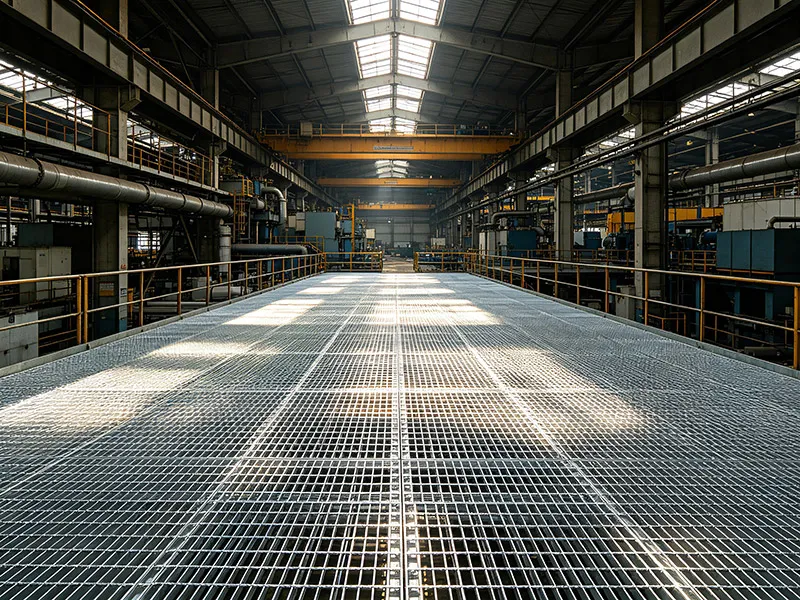
Industrial Manufacturing Plants: Resistance-welded grating is widely used for factory overhead operating platforms, equipment maintenance walkways, workshop trench covers, and logistics passage flooring. Its high load capacity and ventilation performance meet the long-term operation needs of mechanical processing, electronics manufacturing, and light industrial workshops.
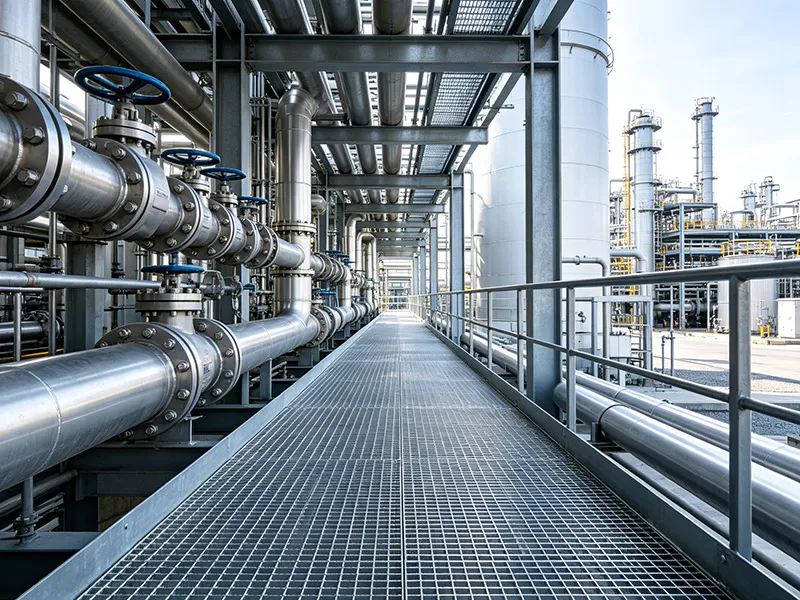
Petrochemical and Refinery Industry: In oilfields, refineries, and chemical plants, anti-corrosion and heavy-duty resistance-welded grating is applied for overhead pipeline walkways, equipment bearing platforms, and sewage trench covers. It adapts to flammable, corrosive, and high-temperature industrial environments, ensuring safe operation of chemical facilities.
Marine and Port Engineering: Stainless steel and hot-dip galvanized resistance-welded grating are the preferred materials for port wharf floors, offshore drilling platform walkways, and ship deck passages. Their excellent salt fog corrosion resistance and wind wave impact resistance meet the strict requirements of marine engineering environments.
Municipal Infrastructure Construction: Urban road drainage trenches, sidewalk drainage covers, park landscape walkways, and municipal bridge passage floors all adopt galvanized resistance-welded grating. Its efficient drainage and durable structure improve the operating efficiency of urban municipal systems.
Commercial and Special Scenarios: Serrated resistance-welded grating is commonly used for car wash shop anti-slip floors, industrial building stair treads, and warehouse ventilation passages, providing safe, durable, and environmentally friendly solutions for commercial and civil industrial scenarios.
Resistance-Welded Grating vs Press-Locked Grating & Riveted Grating: Key Differences
Many B2B buyers confuse resistance-welded grating with other open-grid grating products. A clear performance comparison helps select the most suitable product for industrial projects and avoid improper material selection leading to safety hazards and cost waste.
Resistance-Welded Grating vs Press-Locked Grating: Press-locked grating fixes steel bars through mechanical pressing and clamping without welding. Its joints are purely mechanically assembled, prone to loosening and bar displacement under long-term vibration. In contrast, resistance-welded grating forms metallurgical fusion at bar intersections, with integrated structural strength, no loosening risk, and higher load-bearing capacity. Meanwhile, resistance-welded grating has lower production costs and shorter delivery cycles, making it more suitable for large-scale industrial engineering procurement.
Resistance-Welded Grating vs Riveted Grating: Riveted grating connects steel bars through rivets, with obvious gaps at joints and poor overall integrity. It is easy to accumulate dust and sewage, with poor drainage and anti-corrosion performance. Resistance-welded grating has flat and seamless welding joints, smooth overall surface, better self-cleaning performance, and far higher structural stability, which is more in line with long-term industrial use standards.
Professional Selection Guide for Resistance-Welded Grating
Reasonable selection of resistance-welded grating determines project safety, service life, and comprehensive cost. B2B purchasers and engineers can refer to the following targeted selection principles according to actual working conditions.
Select Material Based on Working Environment: For conventional indoor and dry factory environments, choose economical hot-dip galvanized resistance-welded grating. For coastal, chemical, and highly corrosive environments, prioritize 304/316 stainless steel resistance-welded grating. For humid, slippery, and high-safety scenarios, select serrated anti-slip models.
Match Load-Bearing Specifications with Usage Needs: Pedestrian-only walkways and light-duty platforms adopt standard resistance-welded grating. Equipment passages, mechanical operation areas, and vehicle rolling scenarios must choose heavy-duty thickened grating to ensure sufficient load margin and avoid structural deformation.
Optimize Grid Spacing for Functional Requirements: Scenarios requiring anti-falling and fine drainage adopt dense grid spacing. Industrial platforms and ventilation passages pursuing high air permeability and rapid drainage can choose conventional sparse spacing to balance safety and functional efficiency.
Standardize Surface Treatment Selection: Hot-dip galvanizing is the first choice for outdoor long-term use with excellent anti-corrosion performance. Electro-galvanizing is suitable for indoor low-corrosion environments with cost advantages. Stainless steel passivation treatment is applied for high-standard anti-corrosion and hygiene scenarios.
Conclusion
As a mature and high-performance industrial structural material, resistance-welded grating relies on unique electro-forge welding technology to achieve unparalleled structural stability, safety, and durability. With diversified product types, strong environmental adaptability, and low long-term maintenance costs, it has replaced traditional mechanical assembly grating and become the mainstream choice for global industrial platforms, drainage systems, and safety passage facilities. For B2B industrial buyers, standardized selection, customized specification matching, and high-quality product procurement can maximize the service life and engineering value of resistance-welded grating, bringing stable, safe, and cost-effective solutions for various industrial and municipal engineering projects.