Galvanised Mild Steel Grating: Properties, Uses and Long-Term Value
October 15, 2026
Blog
If you’ve ever compared grating options for an outdoor walkway, industrial platform, or drainage cover, you’ve probably encountered galvanised mild steel grating as the default recommendation from suppliers. It’s the most widely specified grating material in the world for good reason: it offers the right balance of strength, corrosion resistance, weight, and cost — properties that have made it the workhorse of industrial flooring for decades.
But what exactly makes it “galvanised mild steel,” and how does that translate into real-world performance? This guide breaks down the material science behind it, where it excels, where it has limitations, and why its long-term value often makes it the most economical choice over the life of a project — even when upfront alternatives appear cheaper.
What Is Galvanised Mild Steel Grating?
To understand the product, it helps to break the name into two parts.
Mild steel — also known as low-carbon steel — is a steel alloy with a carbon content of roughly 0.05 to 0.25 percent. Compared to high-carbon steel, it’s more ductile, easier to weld, more formable, and significantly cheaper. It’s the material used for everything from structural beams and sheet metal to nails and automotive body panels. Its main limitation is that it rusts readily when exposed to moisture and oxygen.
Galvanising is the process that solves the rust problem. Hot-dip galvanising involves immersing fully fabricated steel grating panels in a bath of molten zinc at around 450°C. The zinc reacts with the steel surface to form a series of zinc-iron alloy layers that are metallurgically bonded to the base metal. The result is a coating that is far more durable than paint or powder coating — one that becomes part of the steel itself rather than sitting on top of it.
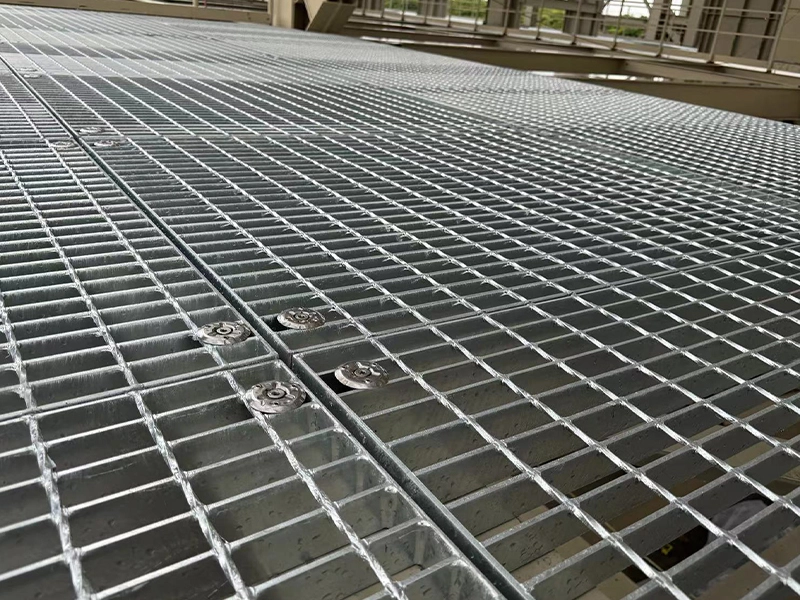
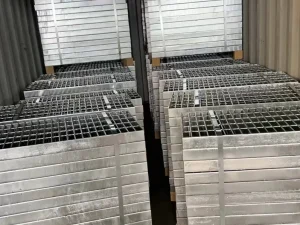
When mild steel grating bars are welded or press-locked into panels and then hot-dip galvanised as a finished unit, you get galvanised mild steel grating. Every surface — including weld points, cut edges, and hidden corners — gets coated, which is critical for long-term corrosion protection.
Key Material Properties
The combination of mild steel and hot-dip galvanising produces a set of properties that make this grating type uniquely versatile.
High Strength-to-Weight Ratio
Mild steel is inherently strong in tension and compression. When formed into grating bars of the correct profile, it can support substantial loads at a relatively low weight per square meter. A standard 30 mm deep pedestrian grating panel weighs roughly 15 to 20 kg per square meter, yet can support concentrated foot loads without excessive deflection.
This matters structurally because lighter flooring means lower dead loads on supporting structures — reducing the required size of supporting beams and the overall steel frame of a platform.
Excellent Corrosion Resistance
The zinc coating in hot-dip galvanising provides two layers of protection:
First, the zinc layer acts as a physical barrier, sealing the steel away from moisture and oxygen. Second, zinc is more electrochemically active than steel, so even if the coating gets scratched or chipped, the zinc corrodes preferentially and protects the exposed steel through a process called cathodic protection. This self-healing property means small areas of damage don’t spread into rust blisters the way they would on painted steel.
In typical atmospheric exposure, hot-dip galvanised mild steel lasts 20 to 30 years without maintenance. In less aggressive rural environments, service life can extend beyond 50 years.
Dimensional Stability and Predictable Performance
Mild steel has consistent, well-characterised mechanical properties that engineers can rely on. Yield strength, tensile strength, and modulus of elasticity are all known quantities, meaning load calculations for china metal grating bar configurations are accurate and predictable. This is important for safety-critical applications where deflection limits and load ratings must be certified.
Weldability and Fabrication
Mild steel is one of the easiest metals to weld. This means grating panels can be easily modified on site — cutting to fit, adding mounting brackets, welding on handrail posts, or repairing damaged sections. The welded areas will need touch-up zinc paint, but the structural modification itself is straightforward.
Non-Combustibility
Unlike wood, plastic, or composite materials, galvanised steel grating is completely non-combustible. It doesn’t burn, emit toxic fumes, or weaken structurally in a fire. This is why it’s the default choice for fire escape routes, industrial platforms in refineries, and buildings with strict fire code requirements.
Magnetic and Non-Sparking Considerations
Mild steel is magnetic, which is useful in certain applications (such as equipment that relies on magnetic clamping or separation). However, it is not non-sparking — so in environments where flammable gases or dust are present, aluminium or stainless steel grating would be specified instead.
Common Applications
The combination of properties above makes galvanised mild steel grating suitable for an enormous range of applications. Here are the most common ones.
Industrial Platforms and Walkways
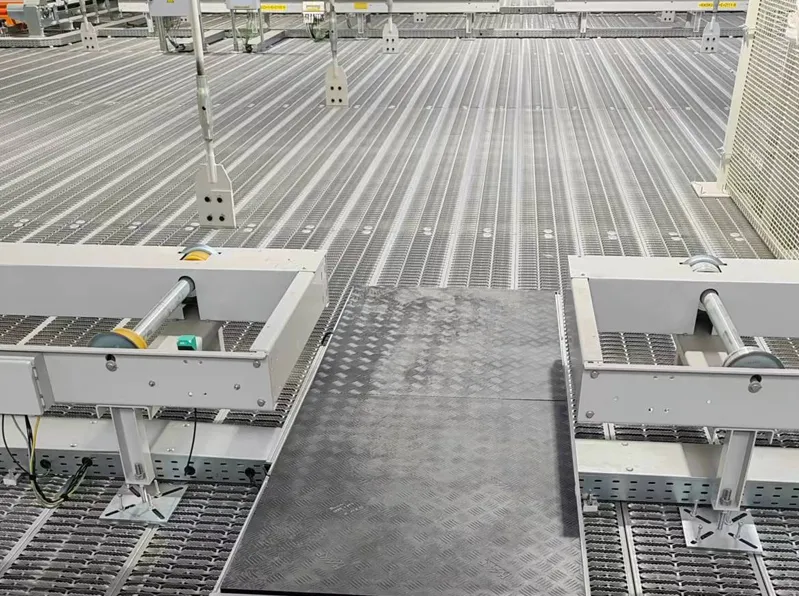
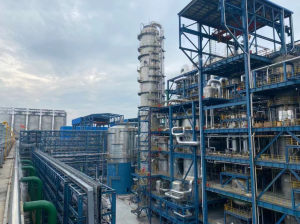
This is the bread-and-butter use case. Refineries, chemical plants, power stations, steel mills, and manufacturing facilities use kilometres of galvanised mild steel grating for access platforms, catwalks, and maintenance walkways. It handles foot traffic, tools, and occasional equipment movement while withstanding the outdoor or semi-outdoor plant environment.
Drainage Covers and Trench Gratings
Galvanized steel grating cover products for drainage channels, floor trenches, and pit covers are almost always made from galvanised mild steel. The combination of corrosion resistance, open drainage, and load capacity makes it the standard for municipal drainage, factory floor trenches, and parking garage drainage systems.
Stair Treads
Industrial stair treads with serrated grating bars and angle steel nosing are typically galvanised mild steel. The serrated surface provides anti-slip traction, and the galvanising ensures outdoor stairs don’t rust in rain or snow.
Bridge Sidewalks and Pedestrian Walkways
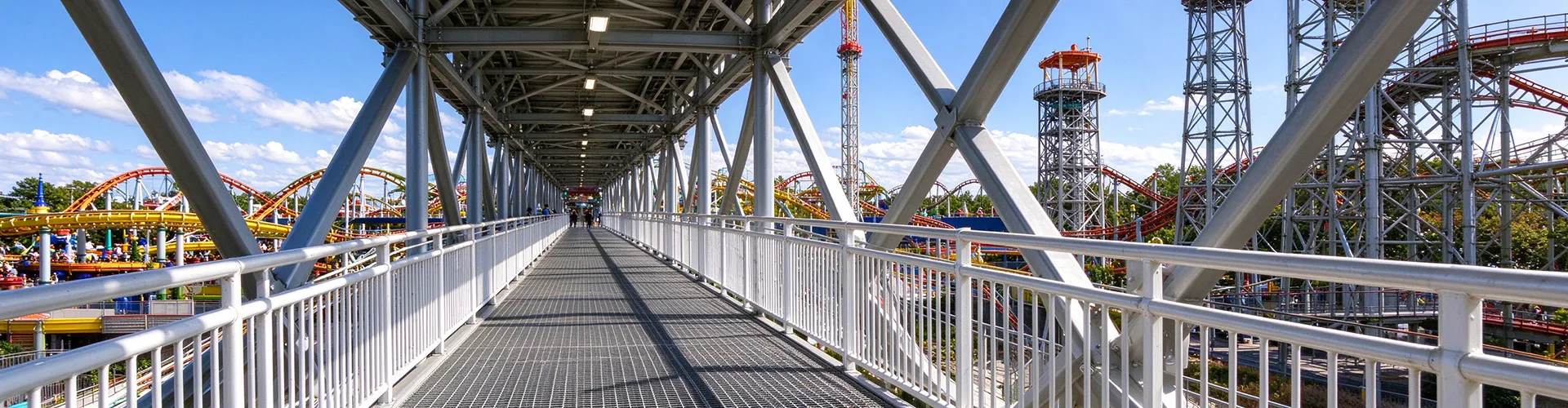
Pedestrian bridges, highway bridge sidewalks, and boardwalks use galvanised grating because it’s lightweight, non-slip when wet, and requires virtually no maintenance over decades of exposure.
Fencing and Security Barriers
In fill panels for security fencing, boundary barriers, and machine guards, galvanised grating provides a rigid, see-through barrier that resists corrosion. The open grid allows visibility and wind penetration while preventing people or objects from passing through.
Agricultural and Livestock Facilities
Farm buildings, dairy parlours, and livestock handling areas use galvanised grating flooring. It resists corrosion from animal waste and cleaning chemicals, drains moisture away, and provides a clean, non-slip surface.
Where It Excels — and Where It Doesn’t
No material is perfect for every application. Understanding the limitations helps you avoid costly specification errors.
It Excels In:
- Outdoor and wet environments where corrosion resistance matters
- Projects where maintenance budget is limited or zero
- Load-bearing flooring where strength-to-weight ratio is critical
- Fire-rated buildings and industrial facilities
- Applications requiring non-combustible materials
- Budget-conscious projects where upfront cost matters but long-term performance is still required
It’s Less Ideal For:
- Immersion in continuous water — While galvanising handles atmospheric moisture well, continuous submersion (such as in underwater structures or constantly submerged tank areas) will wear through the zinc coating faster. For permanent immersion, stainless steel or coated alternatives are better.
- Highly acidic or alkaline environments — Industrial processes involving strong acids, alkalis, or chemical fumes can accelerate zinc corrosion. In these cases, 316 stainless steel or FRP grating is recommended.
- Coastal / marine splash zones — Salt spray accelerates corrosion. While galvanised grating works in coastal areas, stainless steel 316 offers significantly longer service life in salt-heavy environments.
- Food direct-contact surfaces — Where food directly contacts the grating surface, stainless steel 304 or 316 is required for hygiene reasons.
- Decorative or architectural applications — While functional, galvanised grating has a matte, spangled appearance that isn’t considered aesthetic for building facades or public spaces where appearance matters.
Long-Term Value: The Total Cost Equation
One of the most compelling arguments for galvanised mild steel grating is its total cost of ownership. Let’s compare it against common alternatives over a 25-year horizon.
Painted steel grating: Upfront cost may be 20 to 30 percent lower than galvanised. But paint needs touch-up every 2 to 3 years and full repainting every 5 to 8 years. Over 25 years, that’s three to four repainting cycles, plus the cost of scaffolding, labour, and production downtime. By the end, the painted option costs significantly more than galvanised.
Stainless steel grating: Stainless has better corrosion resistance but costs 4 to 5 times more upfront. For applications where galvanised mild steel already provides adequate protection, the premium isn’t justified. Stainless makes sense in chemical or coastal environments where galvanising would fail prematurely, but for general outdoor use, the value gap is hard to justify.
Plastic (FRP) grating: Cheaper upfront and corrosion-resistant, but degrades under UV exposure, has lower load capacity, and typically needs replacement every 10 to 15 years. Two replacement cycles over 25 years erase any initial cost advantage.
The key insight is that galvanised mild steel grating sits at the sweet spot: low upfront cost, minimal maintenance, and 20 to 30 year service life. When you calculate cost per year of service, it’s almost always the lowest-cost option over the full project lifecycle.
How Galvanising Quality Affects Long-Term Performance
Not all galvanising is equal. The quality of the galvanising process directly determines how long the coating lasts. Here’s what to look for when ordering china metal grating sheet products with galvanised finish:
- Coating thickness: Minimum 55 μm for general outdoor use, per ISO 1461 or ASTM A123. Thinner coatings mean shorter service life.
- Uniform coverage: Check that coating is consistent on all surfaces, including inside the grid, at weld points, and on cut edges.
- Adhesion: The zinc layer should be tightly bonded — it shouldn’t flake or peel when scratched.
- Surface finish: A uniform, matte grey appearance with a consistent spangle pattern indicates good process control. Excess ash, rough spots, or bare patches suggest process issues.
Reputable Chinese manufacturers will provide mill test certificates and galvanising test reports on request. If a supplier can’t or won’t provide documentation on zinc coating thickness, that’s a red flag.
Conclusion
Galvanised mild steel grating earns its reputation as the industry standard for good reason. It combines the structural strength of mild steel with the long-lasting corrosion protection of hot-dip galvanising, producing a product that performs reliably in outdoor, wet, and industrial environments for decades with virtually no maintenance.
For most walkway, platform, drainage, and general flooring applications, it’s not just the default choice — it’s the most cost-effective choice when you look at the full lifecycle, not just the initial purchase price.
When you’re ready to specify grating for your project, work with a manufacturer who understands that the difference between a 20-year cover and a 5-year cover comes down to bar profile, coating quality, and engineering detail. Sino Grating produces galvanised mild steel grating to international standards, with full traceability from raw steel coil to finished, packaged panels.
For project-specific quotations or engineering support on your grating requirements, contact Sino Grating today. Share your load requirements, environment, and dimensions — our team will recommend the right galvanised grating configuration for your application and provide a detailed quotation.