Introduction
Modern commercial architecture, MEP mechanical engineering, HVAC systems, and aquatic facility design require specialized grating solutions that prioritize maximum airflow, efficient water drainage, consistent aesthetics, and long-term corrosion resistance. Traditional bar-type steel gratings including welded, swaged, and plug grating are designed for heavy load-bearing performance but often fail to deliver optimal ventilation, anti-clog performance, and uniform visual effects for architectural and mechanical scenarios. Griglia a nido d'ape, also known as cellular egg-box grating, is a uniquely structured open-grid product engineered specifically for ventilation, drainage, and light-duty safety access applications.
Different completely from conventional bar grating’s linear cross-bar structure, eggcrate grating adopts an integrated interlocking cellular grid design, delivering ultra-high open area, self-cleaning performance, and lightweight structural stability. Widely specified by HVAC engineers, commercial architects, swimming pool contractors, and mechanical facility managers, it has become the standard solution for ventilation walkways, pool drainage systems, mechanical plant catwalks, and public building trench covers. This E-E-A-T optimized long-form SEO article elaborates on the definition, manufacturing principles, product types, exclusive advantages, core application scenarios, industry comparisons, and professional selection guidelines of eggcrate grating to support Google ranking and B2B project procurement decisions.
What Is Eggcrate Grating?
Griglia a nido d'ape is a specialized cellular open-grid grating featuring continuous interlocking square or rectangular cell structures, named after its egg-box-style geometric layout. It is an integral molded or fully interlocked assembly grating, independently categorized from traditional bar-type steel gratings. Unlike welded, swaged, or plug gratings that rely on linear bearing bars and cross bars for load support, eggcrate grating forms a unified rigid panel through continuous cellular units, achieving balanced ventilation, drainage, and structural performance.
In professional industrial and architectural terminology, eggcrate grating is defined as a high-open-area functional grating focused on airflow permeability, water drainage, and architectural uniformity rather than extreme heavy-load bearing. Its core structural characteristics include fully symmetrical cellular grids, smooth flat panel surfaces, zero welding protrusions, and consistent open ratios across the entire panel.
Critical industry differentiation clarifies that eggcrate grating is not a substitute for bar grating but a targeted functional grating for ventilation-intensive, wet drainage, and aesthetic architectural scenarios. It fills the market gap where traditional bar gratings suffer from low ventilation efficiency, easy clogging, and uneven visual effects.
Manufacturing Process & Working Principle of Eggcrate Grating
The superior ventilation efficiency, anti-clog performance, and dimensional consistency of eggcrate grating originate from professional integrated molding and precise interlock assembly technology.
Premium Material Selection & Precision Forming
High-grade aluminum alloy, marine-grade stainless steel, or galvanized steel raw materials are selected based on application environments. Raw plates undergo flattening and precision CNC cutting to ensure uniform cell wall thickness and standardized cell size, laying the foundation for consistent grid permeability and structural stability.
Integral Cellular Molding & Interlock Assembly
Eggcrate grating adopts two mature production processes: integral hydraulic molding and precision interlock assembly. Integral molded eggcrate grating forms a one-piece seamless cellular structure without splicing gaps; assembled eggcrate grating uses standardized interlock tenons for tight occlusion, ensuring no displacement or gaps between cellular units. Both processes avoid welding deformation and loose joints common in traditional grating.
Surface Finishing & Anti-Corrosion Treatment
Aluminum eggcrate grating undergoes anodizing or matte brushing treatment; stainless steel versions receive passivation polishing; galvanized steel models adopt hot-dip galvanizing for rust resistance. All finished panels are deburred and leveled to maintain smooth flat surfaces and safe edge details.
Functional Working Principle
The continuous cellular egg-box structure creates an ultra-high open area, enabling unobstructed vertical and horizontal airflow for HVAC ventilation systems. For wet environments, the regular grid guides rapid water penetration and uniform drainage, eliminating standing water. The integrated cell wall structure disperses pressure evenly, ensuring stable light-duty load-bearing capacity while maintaining functional permeability.
Main Types of Eggcrate Grating
Eggcrate grating is classified by material, surface function, and load grade, covering architectural ventilation, mechanical engineering, aquatic facilities, and municipal drainage scenarios.
Aluminum Eggcrate Grating
As the most widely used type, aluminum eggcrate grating features ultra-light weight, high toughness, excellent oxidation resistance, and neat metallic texture. It is easy to cut and install, with outstanding ventilation performance, perfectly matching commercial architectural aesthetic and MEP ventilation requirements. Ideal for HVAC mechanical room walkways, building ventilation ceiling grilles, and public facility ventilation trench covers.
Stainless Steel Eggcrate Grating
Made of 304/316 marine-grade stainless steel, this variant delivers superior acid-base corrosion resistance, salt spray resistance, and waterproof performance. The smooth non-porous cellular surface is easy to clean and free of dirt accumulation, fully adapting to long-term humid and aquatic environments. Widely applied in swimming pool overflow drainage, aquaculture flooring, and wet commercial facility drainage systems.
Galvanized Steel Eggcrate Grating
Hot-dip galvanized steel eggcrate grating enhances structural rigidity and load capacity on the basis of cellular structure. The anti-rust galvanized layer adapts to general industrial environments, providing cost-effective functional performance for mechanical plant maintenance catwalks, factory ventilation platforms, and municipal outdoor drainage facilities.
Serrated Anti-Slip Eggcrate Grating
Serrated eggcrate grating adds precision friction teeth on cellular cell walls and panel surfaces, effectively increasing anti-slip coefficient for wet and slippery conditions. It retains excellent ventilation and drainage performance while solving pedestrian slipping risks, specially designed for pool perimeter walkways, wet mechanical platforms, and rainy outdoor passages.
Fine Mesh Eggcrate Grating
Fine cellular eggcrate grating adopts dense cell layout, improving anti-fall and anti-clog functions without reducing ventilation efficiency. It is suitable for high-altitude mechanical maintenance passages, cleanroom air circulation systems, and public safety ventilation facilities requiring high safety standards.
Exclusive Core Advantages of Eggcrate Grating
Eggcrate grating possesses unique functional and structural advantages that traditional bar-type gratings cannot replicate, making it irreplaceable in ventilation and drainage engineering.
Ultra-High Open Area for Maximum Ventilation Efficiency
The continuous cellular egg-box structure achieves a far higher open ratio than welded, swaged, and plug bar gratings. It ensures unobstructed air circulation, accelerates HVAC system heat dissipation and air exchange, and improves the overall operational efficiency of mechanical ventilation equipment, which is the core advantage for MEP and HVAC engineering applications.
Excellent Anti-Clogging & Self-Cleaning Performance
The regular and smooth cellular grid avoids dead corners and narrow gaps that easily trap dust, leaves, and silt. Rainwater and circulating water can quickly flush surface sundries, realizing natural self-cleaning. It effectively reduces manual cleaning frequency and prevents grid clogging, ensuring long-term stable ventilation and drainage efficiency.
Lightweight Structure & Low Structural Load
Compared with heavy bar grating, eggcrate grating features a lightweight integrated design, greatly reducing bearing pressure on building structures, support frames, and mechanical equipment. It lowers construction difficulty, shortens installation cycles, and reduces overall project structural costs.
Uniform Cellular Aesthetics for Architectural Consistency
The symmetrical and orderly egg-box cellular grid presents a neat and unified visual effect, meeting the high aesthetic requirements of modern commercial buildings, public venues, and landscape facilities. It combines functionality and decoration, improving the overall grade of architectural and mechanical spaces.
Superior Corrosion & Rust Resistance
Aluminum and stainless steel eggcrate gratings have natural anti-oxidation and anti-corrosion properties, adapting to humid, high-temperature, and salt-spray environments. Without welding corrosion weak points, the overall structure maintains long-term integrity and stability, extending service life in harsh working conditions.
Stable Integrated Structure Without Loosening
Integral molding or tight interlock assembly eliminates loose joints and vibration displacement problems common in traditional grating. The unified cellular structure disperses pressure evenly, maintaining flatness and structural stability under long-term pedestrian load and mechanical vibration.
High-Intent Applications of Eggcrate Grating
Targeting high-search-intent Google scenarios, eggcrate grating covers HVAC mechanical engineering, aquatic facilities, commercial architecture, and municipal infrastructure fields.
HVAC Mechanical Room Ventilation Walkways
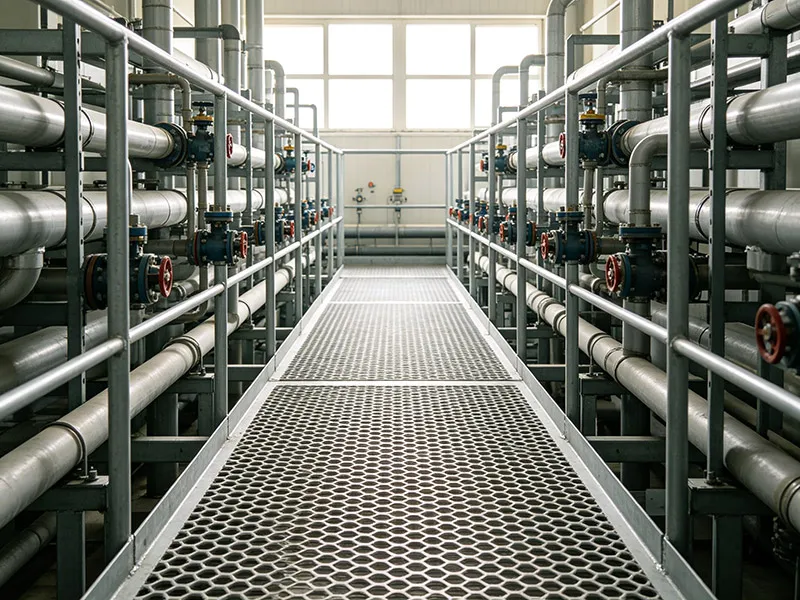
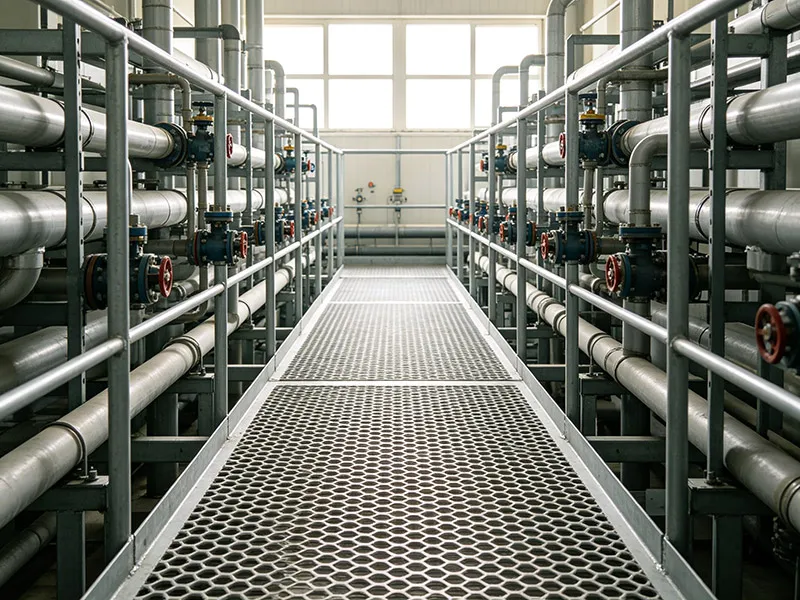
Mechanical equipment rooms, air handling unit platforms, and ventilation pipeline maintenance catwalks widely adopt aluminum eggcrate grating. Its ultra-high ventilation efficiency ensures normal heat dissipation of mechanical equipment, while the lightweight flat structure provides safe pedestrian access for daily equipment inspection and maintenance.
Swimming Pool & Aquatic Facility Drainage Systems
Stainless steel serrated eggcrate grating is the standard solution for swimming pool overflow drainage decks, lazy river perimeter drainage, and aquatic park wet walkways. The efficient cellular grid accelerates water circulation and overflow drainage, and the anti-slip surface ensures pedestrian safety in long-term wet environments.
Commercial Building Ventilation & Decoration
Shopping malls, airport terminals, office buildings, and public venues use eggcrate grating for ceiling ventilation grilles, underground trench covers, and service corridor walkways. Its uniform cellular aesthetics improves indoor space consistency, while excellent ventilation performance guarantees indoor air circulation.
Mechanical Plant & Industrial Catwalks
Light industrial plants, refrigeration equipment rooms, and refrigerant pipeline corridors deploy galvanized and aluminum eggcrate grating for maintenance catwalks. The anti-clog and ventilated structure adapts to long-term mechanical operation environments, ensuring stable equipment heat dissipation and safe passage.
Aquaculture & Marine Farming Facilities
Aquaculture laboratories, marine farming bases, and coastal water facilities use 316 stainless steel eggcrate grating. Its corrosion-resistant and easy-to-clean cellular structure meets the hygienic and drainage requirements of aquatic breeding environments, avoiding sludge accumulation and bacterial growth.
Cleanroom & Sterile Workshop Ventilation Flooring
Dust-free cleanrooms and precision laboratories adopt fine-mesh aluminum eggcrate grating. The smooth non-dust-accumulation surface and efficient air circulation performance maintain indoor sterile and dust-free standards, supporting stable operation of precision production and experimental equipment.
Eggcrate Grating vs Other Types of Steel Grating
Professional product differentiation helps engineers and purchasers accurately select grating products based on project functional requirements.
Eggcrate Grating vs Welded Bar Grating
Welded bar grating focuses on heavy-load bearing but has low ventilation open area, uneven weld surfaces, and easy clogging. It is not suitable for ventilation and drainage priority scenarios. Eggcrate grating completely solves these pain points with ultra-high ventilation efficiency, anti-clog cellular structure, and flat seamless surface. Though less heavy-duty, it is far superior in HVAC, pool, and architectural ventilation projects.
Eggcrate Grating vs Swaged & Swage-Lock Grating
Swaged grating adopts compression interlock bar structure, designed for structural stability and flat walking surfaces, but with limited ventilation performance and single visual effect. Eggcrate grating’s unique cellular structure provides professional ventilation and drainage functions and architectural aesthetics, making it the exclusive choice for functional ventilation scenarios.
Eggcrate Grating vs Plug Steel Grating
Plug grating emphasizes detachable maintenance and high precision, suitable for anti-corrosion industrial platforms, but its linear bar structure cannot achieve uniform ventilation and drainage effects. Eggcrate grating targets functional permeability, with more uniform fluid circulation and better aesthetic performance for building and mechanical ventilation systems.
Professional Selection, Installation & Maintenance Guide
Scientific specification selection and standardized maintenance maximize the service performance and lifespan of eggcrate grating.
Material Selection: HVAC and architectural ventilation scenarios choose lightweight anodized aluminum eggcrate grating; wet pool and aquaculture environments select 304/316 stainless steel anti-corrosion models; general industrial catwalks adopt economical hot-dip galvanized steel types.
Function Selection: Wet slippery passages prioritize serrated anti-slip eggcrate grating; safety anti-fall and cleanroom scenarios choose fine mesh cellular specifications; ordinary ventilation and drainage projects adopt standard conventional cell sizes.
Installation Tips: Use matched fixed brackets for flat laying, ensure seamless splicing between panels, avoid forced extrusion causing cell deformation, and keep cellular grids unobstructed to guarantee ventilation and drainage efficiency.
Daily Maintenance: Eggcrate grating features ultra-low maintenance costs. Regularly flush cellular gaps to remove residual sundries. No welding repair or anti-rust reinforcement is required, maintaining long-term stable functional performance.
Conclusion
Griglia a nido d'ape is a professional functional cellular grating tailored for ventilation, drainage, and architectural aesthetic scenarios. With exclusive advantages of ultra-high ventilation open area, anti-clog self-cleaning performance, lightweight stability, uniform cellular aesthetics, and excellent corrosion resistance, it fills the functional gap of traditional bar-type gratings in HVAC mechanical engineering, aquatic facilities, and commercial architecture fields.
Widely applicable to mechanical room ventilation walkways, swimming pool drainage systems, commercial building ventilation grilles, aquaculture facilities, and municipal drainage projects, eggcrate grating has become the mainstream standardized solution for global MEP engineers and architectural contractors. For projects prioritizing ventilation efficiency, drainage effect, and space aesthetics, eggcrate grating delivers irreplaceable comprehensive value.