Introduction
Wet industrial environments, corrosive chemical workshops, biogas fermentation plants, and wastewater treatment facilities impose extremely strict requirements on industrial grating performance. Traditional welded, swage-locked, and plug bar gratings commonly suffer from inherent flaws such as welding gaps, loose joints, sludge accumulation dead corners, and vibration displacement, which easily cause corrosion acceleration, drainage blockage, and frequent maintenance problems in long-term humid and corrosive working conditions. インターロック式バーグレーチング, a professional tongue-and-groove mosaic interlocking steel grating, perfectly solves these industry pain points with its unique gap-free mechanical interlock structure.
Different completely from all conventional bar grating processing technologies, interlocked bar grating adopts precision CNC stamping tongue-and-groove assembly molding, without welding, hydraulic swaging, or plug splicing gaps. It features seamless interlocking integration, anti-sludge clogging, vibration resistance, anti-corrosion integrity, and stable anti-loosening performance, becoming the most reliable grating solution for high-standard wet and corrosive industrial projects. Optimized for Google E-E-A-T industrial authority and B2B buyer search intent, this long-form SEO article comprehensively elaborates on the definition, manufacturing principle, product classification, core advantages, engineering applications, product comparison, and professional selection guidelines of interlocked bar grating, providing authoritative procurement references for global industrial engineers, facility contractors, and grating distributors.
What Is Interlocked Bar Grating?
インターロック式バーグレーチング is a high-performance industrial open-grid grating based on tongue-and-groove mechanical interlocking technology. It is a new generation of integrated structural grating independently categorized from welded grating, swage-lock grating, and plug grating. Through precision stamping, each bearing bar and cross bar is processed with matched tenon and groove structures, and the overall panel is formed by tight mosaic interlock assembly, realizing full-panel seamless integration.
The core structural feature that distinguishes interlocked bar grating from traditional products is its zero-gap interlocking connection. Conventional gratings inevitably retain assembly gaps or welding crevices, which easily trap organic sludge, sewage sediment, and industrial dust, forming hidden corrosion dead corners. In contrast, interlocked bar grating’s embedded tongue-and-groove locking structure eliminates all gap loopholes. The overall grid is flat, integrated, and tightly connected, with no loose joints or residual gaps, achieving real anti-sludge and anti-clog performance.
In industrial engineering positioning, interlocked bar grating is a professional functional grating tailored for wet drainage, corrosive environments, and vibration-intensive industrial scenarios. It balances structural load-bearing safety, hygienic cleaning performance, and long-term operational stability, making it irreplaceable in biogas, sewage, food hygiene, and chemical anti-corrosion projects.
Manufacturing Process & Interlocking Working Principle
The superior seamless integration, anti-loosening stability, and anti-clog performance of interlocked bar grating stem from standardized precision processing and pure mechanical interlocking assembly technology, with zero thermal damage and zero structural weak points throughout the production process.
Precision CNC Tongue & Groove Stamping Molding
High-quality carbon steel or stainless steel raw materials are selected and precisely leveled. Professional CNC stamping equipment processes standardized matched tenon and groove structures on the joints of bearing bars and cross bars. The fully consistent dimensional tolerance ensures zero clearance fit during subsequent assembly, laying the foundation for seamless interlocking integration.
Mosaic Mechanical Interlock Assembly
Different from the thermal fusion of welded grating and hydraulic compression of swaged grating, interlocked bar grating adopts pure manual and mechanical auxiliary mosaic assembly. The precise tenon structure is tightly embedded in the reserved groove, forming an integrated self-locking structure through physical occlusion force. No external force deformation or thermal stress is generated during the whole process, ensuring the original mechanical properties of the steel material.
Full-Plane Flatness Calibration & Deburring Finishing
After integral assembly, all interlocked grating panels undergo overall flatness correction to eliminate local unevenness. Edge burrs and sharp corners are fully polished to form a smooth, flat, burr-free panel surface, avoiding scratch hazards and reducing residual adhesion of sludge and impurities.
Anti-Corrosion Treatment & Structural Testing
According to application environments, the finished interlocked grating is treated with hot-dip galvanizing or stainless steel passivation. All products pass strict vibration resistance, load-bearing, and gap tightness tests to ensure no loosening, displacement, or deformation during long-term industrial operation.
Core Working Principle
The tongue-and-groove interlocking structure forms an overall rigid force-bearing system. When bearing pedestrian and equipment loads, the force is evenly distributed across the whole panel, avoiding local stress concentration. The gap-free interlock surface ensures smooth sewage runoff, organic sludge cannot adhere and accumulate, and the open grid maintains efficient self-cleaning and drainage performance in wet environments.
Main Types of Interlocked Bar Grating
Interlocked bar grating is classified by material and surface function, covering wet biogas sewage, food hygiene, chemical corrosion, and port logistics scenarios.
Serrated Anti-Slip Interlocked Bar Grating
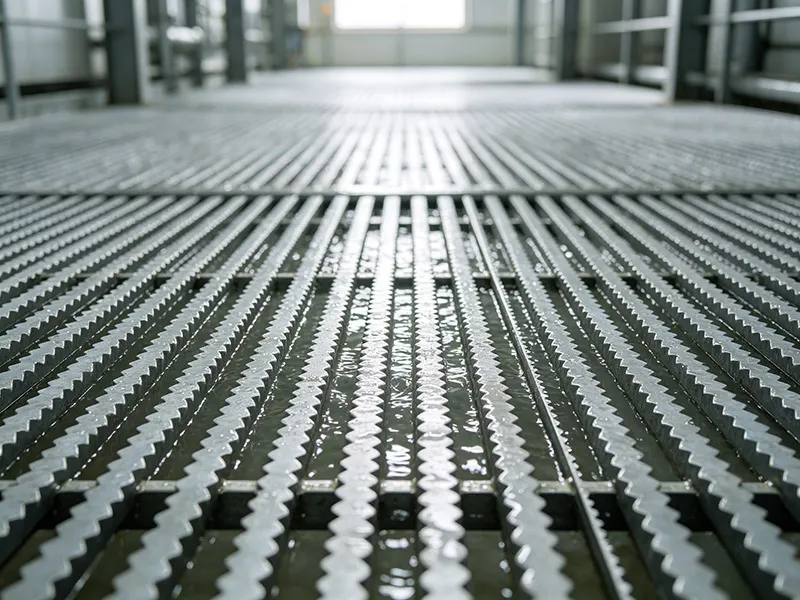
This is the most widely used functional type for wet industrial scenarios. Precision anti-slip serrations are processed on the surface of bearing bars, which greatly improve the surface friction coefficient. Combined with seamless interlock anti-clog structure, it is specially designed for biogas fermentation plant flooring, sewage treatment walkways, and long-term wet industrial platforms, effectively solving pedestrian slipping risks in humid environments.
Stainless Steel Interlocked Bar Grating
Made of 304/316 food-grade and marine-grade stainless steel, this variant has excellent acid and alkali resistance, organic corrosion resistance, and easy cleaning performance. The gap-free interlock structure leaves no hygienic dead corners, which can withstand long-term erosion of biogas slurry, sewage, and chemical volatile substances. It is the preferred choice for food processing factories, biogas plants, and corrosive chemical workshops.
Galvanized Interlocked Bar Grating
Hot-dip galvanized interlocked grating is an economical and durable conventional type. The uniform zinc coating provides reliable rust and oxidation resistance for general industrial and outdoor environments. It retains all advantages of interlock seamless structure and is suitable for port logistics walkways, ordinary industrial maintenance platforms, and municipal drainage facilities.
Heavy-Duty Interlocked Bar Grating
Thickened bearing bar and reinforced interlock joints are adopted to improve overall load-bearing capacity and impact resistance. It can withstand frequent rolling loads and heavy mechanical pressure, suitable for heavy industrial equipment catwalks, port cargo inspection passages, and high-load factory operation platforms.
Exclusive Core Advantages of Interlocked Bar Grating
Compared with all traditional grating products, interlocked bar grating has exclusive structural and functional advantages, perfectly adapting to the harsh operating conditions of wet and corrosive industrial facilities.
Gap-Free Tongue-and-Groove Interlock, Zero Sludge Trap Crevices
The biggest core advantage of interlocked bar grating is the seamless mosaic interlock structure. There are no welding gaps, assembly crevices, or loose splicing gaps on the whole panel. Organic sludge, biogas residue, and sewage sediment cannot be trapped, completely solving the problem of difficult cleaning and secondary corrosion caused by residual dirt in traditional grating gaps.
Vibration-Resistant Self-Locking Structure, No Loosening & Displacement
The embedded tenon-and-groove occlusion forms a permanent self-locking structure. Even under long-term mechanical vibration, equipment operation resonance, and frequent pedestrian load, the grid joints will not loose or displace. It maintains long-term structural integrity and stability, avoiding safety hazards caused by panel dislocation.
Excellent Anti-Slip & Self-Cleaning Performance for Wet Environments
The serrated surface design provides stable anti-slip safety for wet and slippery working surfaces. The uniform linear open grid ensures smooth and rapid sewage runoff, realizing natural flushing and self-cleaning. No manual deep cleaning is required, greatly reducing daily operation and maintenance pressure in wet industrial areas.
Complete Anti-Corrosion Integrity Without Structural Weak Points
Traditional welded grating has welding stress and damaged anti-corrosion layers at welding points, which are the first to corrode and rust. Interlocked bar grating requires no welding processing, and the overall anti-corrosion layer is completely continuous and intact. It effectively resists chemical corrosion, sewage erosion, and salt spray damage, with a far longer service life in harsh environments.
Flat Integrated Surface, No Trip Hazards
The seamless interlock assembly ensures the overall flatness of the grating panel without raised joints or concave gaps. It provides stable and safe passage for pedestrians and maintenance trolleys, meeting the safety specifications of high-standard industrial operation spaces.
Low Maintenance & Long Service Life
With anti-clog, anti-corrosion, and anti-loosening properties, interlocked bar grating requires almost no daily maintenance. It avoids frequent replacement and repair caused by local corrosion and loose joints of traditional grating, greatly reducing the whole life cycle cost of industrial projects.
High-Intent Industrial Applications of Interlocked Bar Grating
Targeting high-value Google search scenarios and B2B engineering procurement demands, interlocked bar grating is widely used in wet, corrosive, and vibration-intensive industrial core scenarios.
Biogas Fermentation Plant Wet Operation Flooring
Biogas plants face long-term erosion of biogas slurry, organic waste residue, and humid gas. Serrated stainless steel interlocked bar grating is specially used for biogas workshop operation flooring. Its gap-free structure prevents organic sludge accumulation, smooth drainage avoids water logging, and anti-slip surface ensures operational safety, fully adapting to the special working environment of biogas production.
Wastewater & Sewage Treatment Plant Walkways
Sewage treatment facilities have high requirements for drainage efficiency and anti-fouling performance. Interlocked bar grating’s uniform linear grid accelerates sewage circulation and residue filtration, and the seamless interlock structure avoids corrosion dead corners. It is widely laid on aeration tank surrounding walkways and sewage inspection passages.
Food & Beverage Factory Hygienic Passages
Food processing and brewing industries require high hygienic standards for workshop passages. Stainless steel interlocked bar grating has no dirt accumulation gaps, is easy to clean and disinfect, and has no hidden sanitary hazards. It meets food-grade production environment requirements and is the ideal grating for food factory maintenance passages and wet operation areas.
Chemical Plant Corrosive Environment Platforms
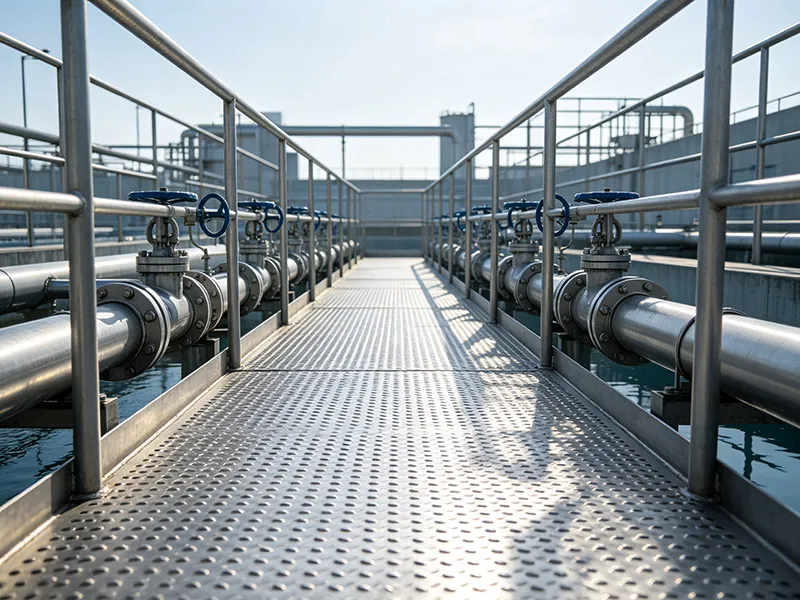
Chemical workshops have volatile acid-base gases and corrosive liquid splashes. Interlocked bar grating’s complete anti-corrosion layer and gap-free structure resist chemical erosion, avoid local corrosion damage, and maintain long-term stable structural performance for chemical operation platforms and pipeline catwalks.
Port Logistics Outdoor Anti-Slip Walkways
Coastal port environments are humid and saline-alkali corrosive with frequent pedestrian traffic. Galvanized and stainless steel interlocked bar grating features anti-slip, anti-corrosion, and vibration-resistant performance, suitable for port inspection walkways, cargo channel passages, and outdoor logistics platforms.
Vibration-Intensive Mechanical Equipment Catwalks
Mechanical operation workshops have long-term equipment vibration. The self-locking interlock structure of interlocked bar grating effectively resists vibration displacement and joint loosening, ensuring the stability and safety of equipment maintenance catwalks during long-term mechanical operation.
Interlocked Bar Grating vs Other Grating Types
Professional product differentiation helps engineers and purchasers accurately select grating products according to environmental characteristics and project standards.
Interlocked Bar Grating vs Welded Bar Grating
Welded grating relies on thermal welding molding, with inevitable welding gaps, solder bumps and thermal deformation. Welding points are prone to corrosion and sludge accumulation, and local damage requires overall replacement. Interlocked bar grating adopts seamless tongue-and-groove interlock without welding, zero dirt dead corners, complete anti-corrosion performance and stable vibration resistance. It is far more suitable for wet and corrosive industrial scenarios than welded grating.
Interlocked Bar Grating vs Swage-Lock Grating
Swage-lock grating is formed by hydraulic compression locking, with integrated non-detachable structure but reserved micro gaps at compression joints, which still accumulate fine sludge. Long-term vibration easily causes joint loosening. Interlocked bar grating achieves true zero-gap integration through mosaic interlock, with better anti-clog and anti-loosening performance, more suitable for high-standard hygienic and wet industrial projects.
Interlocked Bar Grating vs Plug Steel Grating
Plug grating focuses on detachable maintenance, but its plug-in assembly will retain tiny splicing gaps, which cannot avoid sludge accumulation. Interlocked bar grating pursues seamless overall integration, prioritizing anti-clog hygienic performance and structural stability, and is more targeted for wet sewage and biogas industrial environments.
Interlocked Bar Grating vs Eggbox/Eggcrate Grating
Eggbox and eggcrate cellular grating focus on ventilation and large-flow drainage, but their cellular structure is easy to trap floating impurities. Interlocked linear bar grating has smoother sewage runoff and easier manual flushing, with stronger structural vibration resistance, more suitable for industrial production operation platforms rather than architectural ventilation scenarios.
Professional Selection, Installation & Maintenance Guide
Scientific specification selection and standardized operation can maximize the service performance and service life of interlocked bar grating.
Material Selection Rules: Biogas plants, sewage treatment and food hygiene workshops select 304/316 stainless steel interlocked grating; ordinary industrial vibration platforms and port outdoor passages choose economical hot-dip galvanized models; heavy-load equipment platforms adopt thickened heavy-duty specifications.
Surface Function Selection: All long-term wet and slippery industrial areas must select serrated anti-slip interlocked grating; dry indoor maintenance platforms can adopt plain flat type to balance flatness and cost.
Installation Standards: Adopt professional supporting fixing brackets for overall flat laying, ensure tight interlock docking between panels, avoid forced extrusion damaging tongue-and-groove structure, and keep grid gaps unobstructed to guarantee drainage and self-cleaning efficiency.
Daily Maintenance Tips: Interlocked bar grating has ultra-low maintenance costs. Regular simple water flushing can complete surface cleaning without dead corners. The integrated self-locking structure requires no regular reinforcement and repair, realizing long-term trouble-free operation.
Conclusion
インターロック式バーグレーチング is a high-performance industrial grating specially developed for wet, corrosive and vibration-intensive industrial scenarios. With exclusive tongue-and-groove seamless interlock structure, it solves the inherent sludge accumulation, joint loosening and local corrosion pain points of traditional welded, swage-lock and plug gratings. Its core advantages of anti-clog hygiene, vibration resistance, anti-slip safety and complete anti-corrosion integrity make it irreplaceable in biogas fermentation plants, sewage treatment facilities, food hygiene workshops and chemical industrial platforms.
As a high-cost-performance and high-stability industrial grating solution, interlocked bar grating has been widely recognized by global industrial engineers and contractors. For wet industrial projects pursuing long-term stability, low maintenance and high hygienic standards, interlocked bar grating is the most professional and reliable choice.