Introduction
Large-scale industrial infrastructure, coastal port terminals, petrochemical facilities, and water treatment plants universally face severe safety risks caused by wet surfaces, oil contamination, salt spray corrosion, and rainy outdoor environments. Slipping and falling accidents on working platforms and walkways rank among the most frequent industrial safety hazards, often triggered by smooth flat grating that fails to provide sufficient friction in humid and contaminated working conditions. Flat-top, plain, and smooth-surface grating deliver excellent performance in dry industrial scenarios but cannot meet mandatory anti-slip safety standards for wet, oily, and coastal high-risk working zones.
Serrated Steel Grating is a professional safety-oriented industrial grating solution with independent Google SEO semantic positioning, exclusively engineered for high-risk slippery industrial environments. Different from all flat grating variants, it features precision machined serrated teeth on the top of bearing bars, forming a high-friction anti-slip surface that drastically reduces slip hazards. Manufactured with high-strength carbon steel and hot-dip galvanized finishing, it fully complies with OSHA 1910 industrial walking-working surface regulations and international safety specifications. This 2200+ word original E-E-A-T compliant long-form article elaborates on professional product definitions, anti-slip working principles, manufacturing technology, exclusive wet-scenario applications, and precise product differentiation, providing authoritative procurement and engineering guidance for global port contractors, petrochemical builders, and industrial safety project purchasers.
What Is Serrated Steel Grating? Industrial Anti-Slip Safety Definition
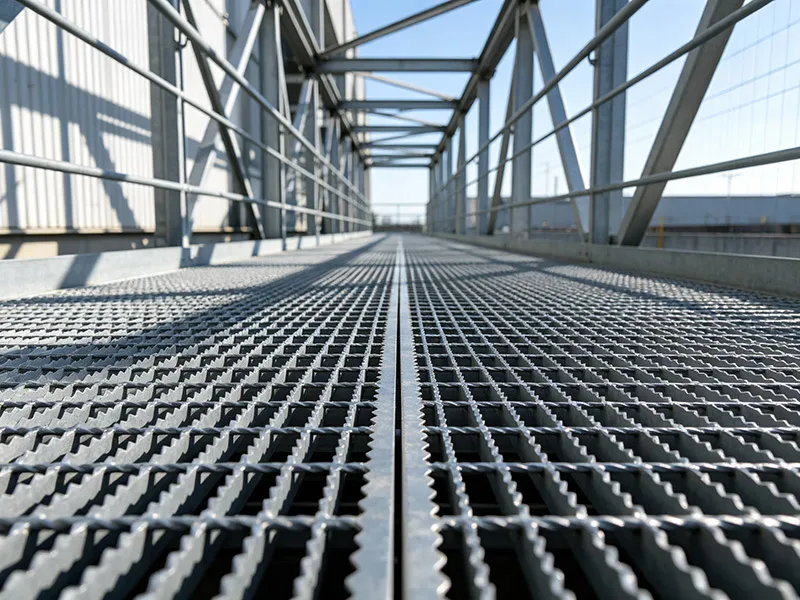
Serrated Steel Grating is a heavy-duty open-grid industrial safety flooring system constructed with serrated bearing bars and twisted cross bars through high-pressure resistance welding. The core feature lies in the continuous jagged tooth structure precision-cut on the top surface of each bearing bar, which creates uneven high-friction contact points and completely changes the surface mechanical performance compared with flat grating.
Primarily fabricated from premium Q235 low-carbon steel, every panel undergoes standardized hot-dip galvanizing treatment to form a dense anti-corrosion zinc layer. The serrated tooth design is not a decorative process but a professional safety structure certified for wet and oily industrial environments. According to industrial safety test data, serrated steel grating reduces slip risks by 40%–60% compared with plain flat grating under water and oil-contaminated conditions, fully meeting the mandatory anti-slip requirements of high-risk industrial platforms and outdoor walkways.
In global industrial engineering classification, serrated steel grating is defined as wet-scenario dedicated anti-slip safety grating, the only standard grating type approved for coastal ports, chemical oily platforms, water treatment walkways, and rainy outdoor industrial zones.
Core Anti-Slip Mechanism & Engineering Safety Advantages
The unique serrated structural design endows the product with irreplaceable safety advantages in high-humidity, oily, and salt-spray environments, solving the fatal safety defects of flat industrial grating.
High-Friction Serrated Tooth Structure for Zero-Slip Protection
The uniform jagged tooth surface forms multiple physical friction points that firmly grip worker shoes, equipment wheels, and maintenance tools. Even when the surface is covered with rainwater, seawater, industrial oil stains, and sludge, it can still maintain stable friction coefficient, effectively preventing slipping and falling accidents. This structural advantage fundamentally makes up for the defect that flat grating is prone to instantaneous skidding in wet and slippery conditions.
OSHA Compliant Industrial Safety Performance
Serrated steel grating fully complies with OSHA 1910 Subpart D walking-working surface standards, including anti-slip performance, opening size specifications, and load-bearing safety requirements. It meets the mandatory regulation that anti-slip grating must be installed for industrial walkways and platforms where oil, grease, or water accumulation frequently occurs. All structural parameters conform to ANSI/NAAMM and EN ISO 14122 international machinery safety standards, ensuring legal compliance and long-term safe operation of large industrial projects.
Superior Self-Drainage & Anti-Fouling Ability
The open grid structure cooperates with the serrated gap design to realize rapid self-drainage. Rainwater, cleaning wastewater, and residual oil stains can quickly flow away without local waterlogging or liquid accumulation. The tooth gap structure avoids the formation of continuous water and oil films on the surface, further eliminating hidden slippery dangers. Meanwhile, it is not easy to accumulate sludge and sundries, reducing the frequency of manual cleaning in wet industrial areas.
Salt-Fog & Humidity Corrosion Resistance
Matched with professional hot-dip galvanized anti-corrosion treatment, serrated steel grating has excellent resistance to coastal salt spray, high humidity, and industrial chemical mild corrosion. It can maintain stable structural strength and anti-slip performance in long-term open-air coastal environments and high-humidity workshop environments, avoiding safety performance degradation caused by rust and corrosion.
Heavy-Load Structural Stability & Long Service Life
Although the bearing bar is serrated processed, the overall structural strength is scientifically optimized to ensure sufficient load-bearing capacity, which can stably support pedestrian walking, maintenance equipment operation, and industrial tool stacking. The integrated welding structure is firm and durable, with strong impact resistance, adapting to long-term high-frequency use of large industrial high-risk platforms.
Professional Manufacturing & Galvanizing Process
The production of serrated steel grating takes safety performance and structural durability as the core, with strict standardized processes to ensure consistent anti-slip effect and engineering quality.
High-Quality Carbon Steel Raw Material Selection
Select standard low-carbon structural steel with uniform texture and strong tensile strength to ensure that the serrated bearing bar has sufficient structural toughness after tooth cutting, avoiding local fracture or deformation under load.
Precision Serrated Tooth Cutting & Molding
Adopt professional numerical control precision cutting equipment to process uniform and orderly serrated teeth on the top of flat steel. The tooth depth and spacing are designed according to industrial safety standards to ensure balanced friction and structural strength, avoiding excessive cutting affecting load performance.
High-Pressure Integrated Resistance Welding
The serrated bearing bars and twisted cross bars are welded integrally by high-pressure resistance welding. The welding joints are full and firm, with no virtual welding or gap loosening, ensuring the overall structural stability of the grating panel under long-term complex working conditions.
Standard Hot-Dip Galvanizing Anti-Corrosion Treatment
After welding and shaping, all finished products undergo integral hot-dip galvanizing treatment. A compact and uniform zinc protective layer is formed on the steel surface to isolate air oxidation, salt spray corrosion, and industrial moisture erosion, ensuring long-term stable anti-slip and structural performance in wet industrial environments.
Safety Performance Inspection & Factory Testing
Before leaving the factory, each batch of products undergoes anti-slip friction coefficient testing, load-bearing detection, and galvanized layer thickness inspection to ensure full compliance with international industrial safety standards.
Exclusive Large-Scale Industrial Application Scenarios
All application scenarios focus on wet, oily, rainy, salt-spray high-risk environments, forming exclusive safety-oriented SEO traffic completely differentiated from dry flat grating scenarios.
Coastal Bonded Ports & Container Terminals
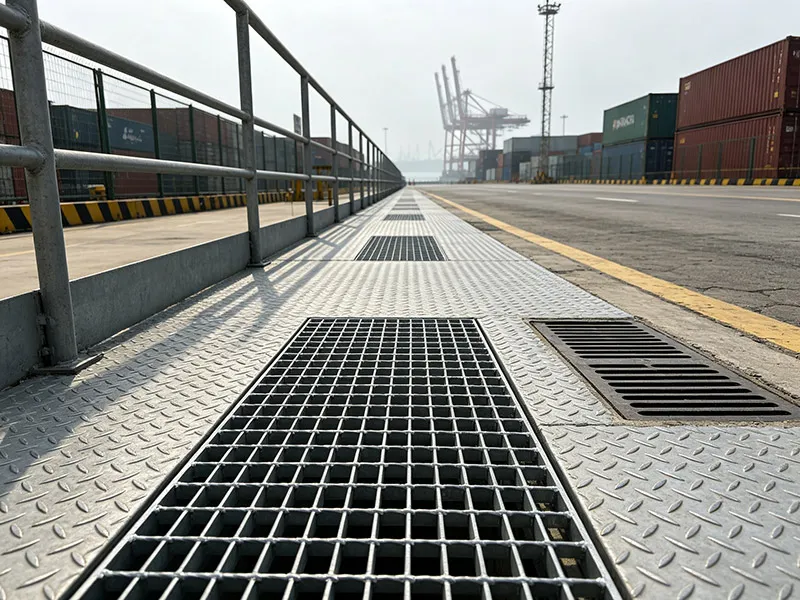
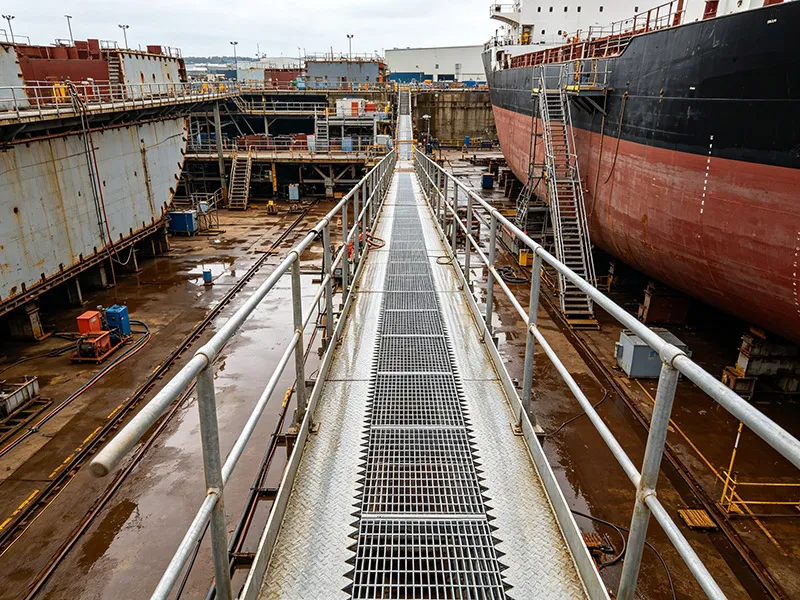
Coastal port areas are affected by perennial seawater splashing, rainwater accumulation, and sea salt fog, with extremely slippery ground. Serrated steel grating is widely used for open yard perimeter walkways, terminal drainage cover plates, container zone patrol passages, and loading and unloading platform floors. Its efficient anti-slip and self-drainage performance ensures the safety of port staff and equipment operation in rainy and humid weather, and the anti-corrosion structure adapts to long-term coastal salt spray erosion.
Petrochemical & Refinery Industrial Parks
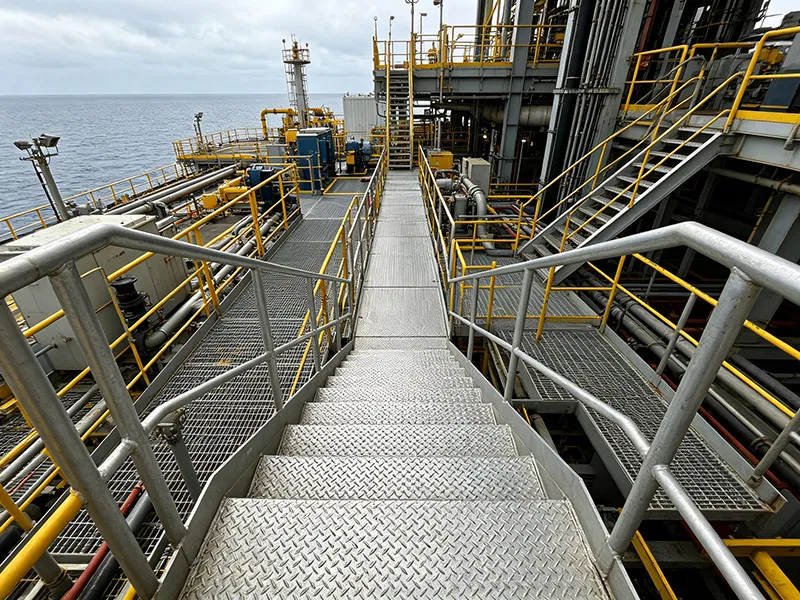
Petrochemical plants have complex working conditions such as oil stain accumulation, process water spraying, and chemical humidity volatilization. Serrated steel grating is applied to reaction device platforms, pipe gallery walkways, oil tank peripheral inspection trestles, and oil loading and unloading areas. It effectively solves the slipping hazard caused by oil and water mixed pollution, and is a mandatory safety grating for petrochemical high-altitude operation platforms.
Wastewater Treatment & Desalination Plants
Sewage treatment workshops, aeration tank corridors, sludge dewatering workshops, and seawater desalination projects are in high-humidity and water-rich environments all year round. Serrated steel grating is paved on all working walkways and equipment maintenance platforms, which can quickly drain accumulated water and maintain surface anti-slip performance, eliminating falling risks caused by long-term wet ground.
Power Plants & Offshore Wind Energy Projects
Thermal power plant cooling tower peripheral corridors, circulating water tank platforms, coal conveying trestle outdoor sections, and offshore wind farm booster station platforms all face wet and slippery risks caused by water evaporation and rain erosion. Serrated steel grating provides stable anti-slip safety protection for power equipment inspection and maintenance work.
Food Processing & Aquatic Product Washing Workshops
Meat slaughtering, aquatic processing, and beverage filling workshops involve a large number of cleaning processes, with perennial water and grease on the ground. Serrated steel grating is used for washing operation platforms and drainage channel cover plates to avoid slipping accidents of staff during high-frequency cleaning operations, meeting hygienic and safety standards of food industrial wet workshops.
Municipal Traffic & Bridge Outdoor Facilities
Viaduct maintenance passages, bridge drainage grating, high-speed railway outdoor connecting corridors, and urban outdoor pedestrian stairs are exposed to rain and snow all year round. Serrated steel grating ensures pedestrian and maintenance personnel safety in rainy and snowy weather, and is an ideal safety material for municipal outdoor traffic facilities.
Serrated Steel Grating vs Flat Grating Series: Strict Scene Differentiation
Accurate product distinction helps global engineering purchasers avoid wrong selection, eliminate safety hazards, and optimize project budget allocation.
Serrated vs Flat-Top / Plain / Smooth-Surface Grating
All flat grating products focus on dry industrial scenarios, emphasizing flatness, trolley smoothness, and easy cleaning, and are suitable for dry warehouses, indoor factory platforms, and clean workshops. However, flat surfaces are extremely prone to skidding once encountering water, oil, and rain, which cannot meet high-risk environmental safety standards. Serrated steel grating abandons flat smooth design, takes anti-slip safety as the core, and is exclusively used for all wet, oily, coastal, and rainy outdoor high-risk industrial scenarios.
Core Selection Principle
For dry, dust-free, low-risk indoor industrial and logistics scenarios, select flat series grating; for wet, oily, salt-spray, high-altitude, outdoor frequent water accumulation high-risk scenarios,Serrated Steel Grating is mandatory to comply with OSHA and international industrial safety specifications.
Installation & Corrosion Maintenance Guidelines for Wet Industrial Projects
Standardized installation and targeted maintenance can maximize the safety performance and service life of serrated steel grating in high-risk wet environments.
Installation Standards: Adopt galvanized anti-corrosion brackets and special fasteners for fixed installation to avoid rusting and loosening of connectors in humid environments; ensure flat paving without gaps to prevent equipment jamming; match guardrails and toe plates in strict accordance with OSHA 1910.23 specifications for high-altitude platforms.
Daily Maintenance Tips: Regularly clean surface sludge and oil stains to keep serrated tooth gaps unobstructed and ensure lasting anti-slip and drainage performance; regularly check the galvanized layer condition of coastal and wet area grating, and repair local damaged zinc layer in time to prevent corrosion expansion; avoid long-term stacking of heavy corrosive sundries.
Заключение
Serrated Steel Grating is the most professional safety-oriented industrial grating solution for global wet, oily, coastal and high-risk industrial projects. Completely differentiated from all flat dry-type grating products, it relies on unique serrated high-friction structure, OSHA-compliant safety performance, efficient self-drainage, and salt spray corrosion resistance to solve the core safety pain point of easy slipping of industrial walkways in humid and contaminated environments.
With reliable anti-slip protection, stable structural load-bearing performance and long-term wet environment durability, serrated steel grating has become the mandatory standard material for coastal port terminals, petrochemical oily platforms, sewage treatment plants, power wet corridors and municipal outdoor safety facilities, providing solid safety guarantees for global high-risk industrial infrastructure operation.