China Metal Grating Sheet: Types, Applications and Cost Overview
October 15, 2026
Blog
If you’re comparing quotes for industrial flooring, drainage covers, or platform walkways, you’ve probably encountered the term “metal grating sheet” from multiple Chinese suppliers — only to find that the same description covers products with wildly different performance and price points. The reason is simple: metal grating sheets are not a single commodity. They’re a family of products defined by bar material, manufacturing method, surface treatment, and load rating, and choosing the wrong type for your application can mean premature failure or overpaying for specs you don’t need.
This guide breaks down the main types of China metal grating sheet available today, where each one performs best, and how pricing breaks down so you can compare supplier quotes with confidence.
What Is a Metal Grating Sheet?
A metal grating sheet is a prefabricated panel made from an assembly of parallel load-bearing bars welded or mechanically locked to transverse cross bars, creating a uniform grid pattern. The open design makes it ideal for applications where drainage, ventilation, light transmission, or debris passage is required — while still supporting heavy pedestrian or vehicle loads.
Finished sheets are typically manufactured in standard panel sizes and then cut to custom dimensions on site or at the factory. The quality of the individual china metal grating bar components — the depth, thickness, and material grade of the parallel load-bearing elements — determines the final sheet’s load capacity and deflection resistance. The base materials range from mild steel to stainless steel and aluminium, with surface treatments that determine corrosion resistance and service life.
Main Types of China Metal Grating Sheet
Chinese manufacturers produce several distinct grating sheet variants. Understanding the differences helps you specify the right product rather than accepting whatever the supplier defaults to.
Welded Steel Grating Sheets
Welded grating is the most common and cost-effective type produced in China. Main load bars are resistance-welded to twisted square cross bars at each intersection. The process is fast, consistent, and suitable for high-volume production runs.
Best for: General-purpose industrial walkways, drainage trenches, platform flooring, and equipment access areas where budget is a primary concern.
Typical specs: Main bars 20×3 mm to 50×5 mm, bar spacing 30 mm or 40 mm, cross bar spacing 50 mm or 100 mm.
Press-Locked (Swage) Grating Sheets
Press-locked grating uses hydraulic pressure to swage cross bars into pre-punched slots in the main bars, creating a rigid mechanical joint rather than a weld. The result is a cleaner visual appearance, stronger resistance to joint deformation under point loads, and no visible weld spatter.
Best for: Architectural facades, catwalks in high-visibility areas, stair treads, and applications where dynamic loading or impact is expected.
Typical specs: Deeper bar profiles (40 mm to 75 mm) for heavy-duty loads, finer spacing options for anti-slip requirements.
Galvanised Mild Steel Grating Sheets
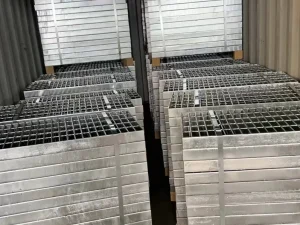
When mild steel grating (welded or press-locked) is hot-dip galvanised after fabrication, it becomes galvanised mild steel grating — the workhorse of the industry. The zinc coating provides decades of corrosion protection in outdoor and wet environments.
This is the most widely exported grating sheet type from China, accounting for the majority of orders destined for Europe, Australia, the Middle East, and Southeast Asia.
Best for: Outdoor walkways, bridge sidewalks, sewage treatment plant platforms, coastal infrastructure, and any exterior application where painting and repainting would be impractical.
Galvanized Steel Grating Cover Sheets
A specialized sub-category, galvanized steel grating cover refers to grating panels used specifically as trench covers, drainage covers, or pit covers. These are often reinforced with angle steel edge frames and may include a hinge or lifting mechanism for access.
Best for: Municipal drainage channels, factory floor trenches, garage drainage, airport perimeter drainage, and any location where a removable, load-bearing cover is needed.
Stainless Steel Grating Sheets
Stainless steel grating uses grade 304 or 316 stainless steel bars for maximum corrosion resistance. It requires no additional coating and maintains its appearance for decades.
Best for: Food processing plants, pharmaceutical facilities, chemical plants, coastal offshore platforms, and architectural interiors where aesthetics matter.
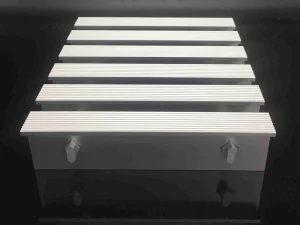
Aluminium Grating Sheets
Aluminium grating is lightweight, non-sparking, and naturally corrosion-resistant. It’s roughly one-third the weight of steel grating, making it ideal for applications where dead load is a concern.
Best for: Offshore oil rig walkways, architectural screens, sunshades, and temporary or demountable structures.
Compound (Composite) Grating Sheets
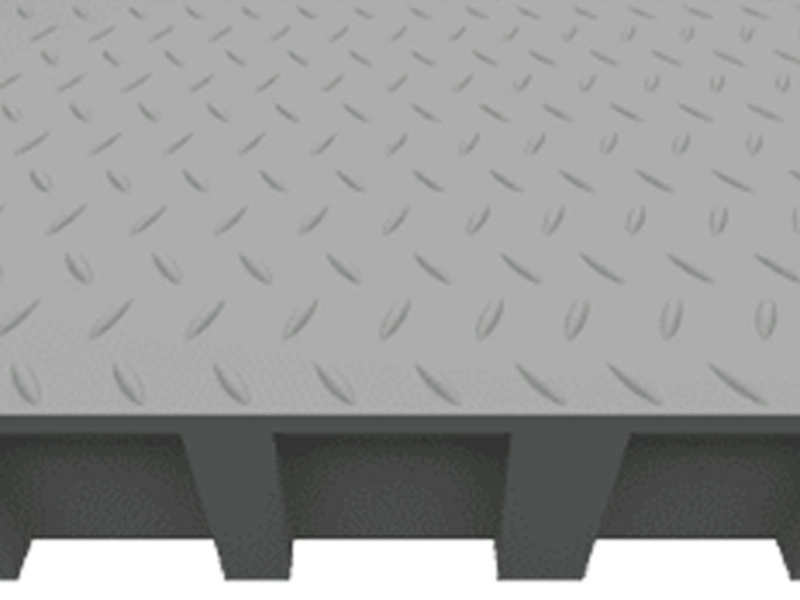
Compound grating combines a layer of checkered steel plate bonded on top of a steel grating base. The checkered plate provides a solid, non-slip walking surface, while the grating underneath provides structural support and drainage.
Best for: Stair treads, ramps, loading docks, and areas where both a solid walking surface and drainage underneath are required.
How to Choose the Right Type for Your Application
Selecting the correct metal grating sheet comes down to matching the product to your specific operating conditions. Ask these four questions:
1. What is the load requirement? Pedestrian walkways need 25 mm to 30 mm deep bars. Light vehicle traffic (forklifts, utility vehicles) needs 40 mm to 50 mm depth. Heavy truck or forklift traffic on industrial floors requires 65 mm to 75 mm deep bars, often in a press-locked configuration.
2. What is the environment? Indoor dry environments can use black (uncoated) or painted grating. Outdoor or wet environments require hot-dip galvanised mild steel grating. Chemical exposure or coastal salt air points to 316 stainless steel.
3. Is drainage or debris passage required? Open grating allows water, light, and debris to pass through. If you need a solid walking surface but want drainage underneath, compound grating is the answer. If you need to cover a trench but still allow water entry, standard galvanized steel grating cover panels are designed exactly for this.
4. Is appearance important? For industrial back-of-house areas, welded galvanised grating is the economical choice. For public areas, building facades, or customer-facing facilities, press-locked grating or stainless steel grating offers a cleaner, more uniform appearance.
Cost Overview: What Drives Metal Grating Sheet Pricing
Understanding the cost structure helps you compare quotes and identify where you can save — or where a low quote might indicate a corner being cut.
Base Material Cost
The single largest cost factor is the raw material. In 2026 market conditions, approximate relative pricing per square meter is:
- Mild steel (black): Base level, the cheapest option
- Hot-dip galvanised mild steel: Typically 15 to 25 percent more than black steel, due to the zinc coating process
- Aluminium: Approximately 2.5 to 3 times the cost of galvanised mild steel
- Stainless steel 304: Roughly 3.5 to 4 times the cost of galvanised mild steel
- Stainless steel 316: Approximately 4.5 to 5 times the cost of galvanised mild steel
Manufacturing Method
Welded grating is the most economical production method. Press-locked grating commands a 10 to 20 percent premium due to slower production speeds and more precision tooling.
Bar Profile and Spacing
Deeper bars use more steel and cost more. A 75 mm deep heavy-duty sheet can cost nearly twice as much as a 30 mm deep pedestrian sheet. Similarly, closer bar spacing (more bars per square meter) increases cost, while wider spacing reduces it.
Edge Frames and Accessories
Adding angle steel edge frames, end plates, hinges, lifting eyes, or anti-slip serrations all add to the final price. A basic sheet vs. a fully fabricated galvanized steel grating cover with frame and hinge can differ by 30 percent or more.
Quantity and Lead Time
Standard sizes in bulk (full container loads, 200+ square meters) achieve the lowest per-square-meter pricing. Small orders, custom sizes, and expedited shipments carry premiums.
Rough Price Benchmarks (FOB China, 2026)
For reference, typical price ranges for standard hot-dip galvanised mild steel grating sheets are:
- 25×3 mm welded, 30×100 mm spacing: $30 – $45 per square meter
- 30×3 mm welded, 30×100 mm spacing: $35 – $55 per square meter
- 40×5 mm press-locked, 30×100 mm spacing: $60 – $85 per square meter
- 50×5 mm heavy-duty welded: $70 – $100 per square meter
These are rough ranges for budget planning only. Actual quotes depend on exact specifications, order volume, current steel market prices, and factory location. Always request formal quotes from multiple suppliers with identical specifications for an accurate comparison.
Common Applications by Grating Sheet Type
Different industries rely on different grating sheet types. Here’s how the most common applications map to product selection:
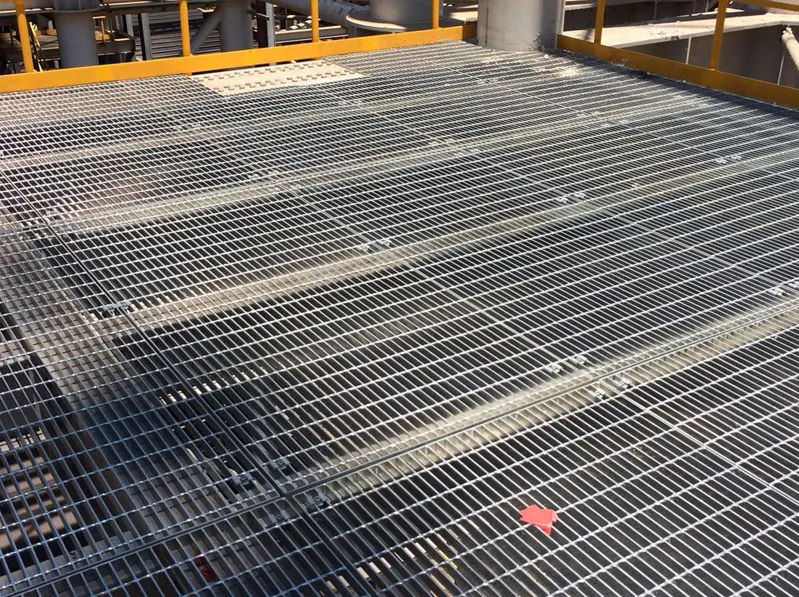
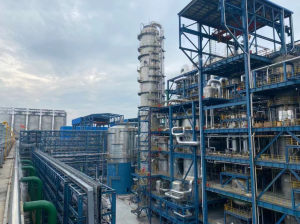
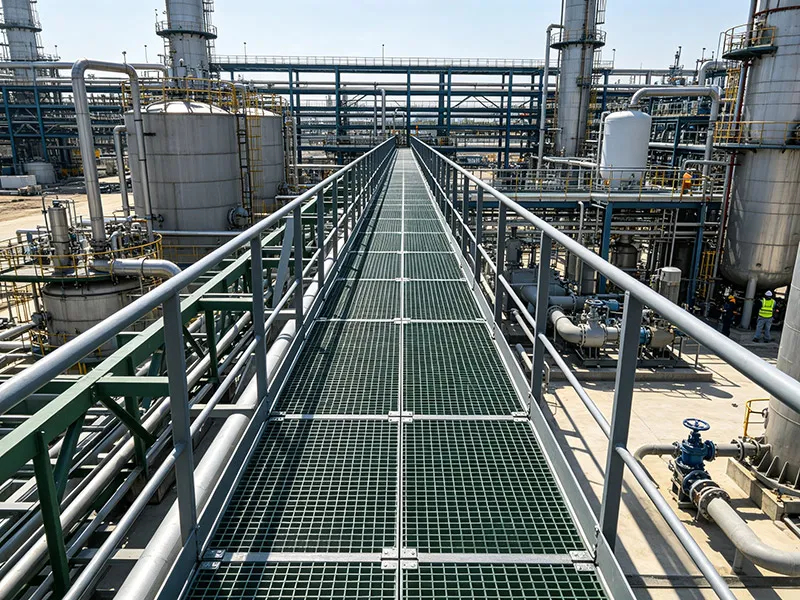
Industrial platforms and walkways — Galvanised mild steel welded grating is the default choice for refineries, chemical plants, power stations, and manufacturing facilities. The combination of corrosion resistance, load capacity, and cost makes it the standard for industrial use worldwide.
Drainage and trench covers — Galvanized steel grating cover panels with steel edge frames are specified for road drainage, factory floor trenches, and parking garage drainage systems. Load class ( pedestrian, light vehicle, heavy vehicle) determines bar depth and frame thickness.
Stair treads — Serrated grating treads with angle steel nosing are common in industrial and commercial buildings. The serrated bar surface provides anti-slip traction in wet or oily conditions.
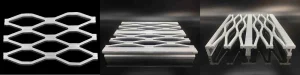
Architectural and decorative use — Press-locked aluminium or stainless steel grating is used for building facades, sunscreens, balustrade infill panels, and decorative screens where the grid pattern is part of the design aesthetic.
Food and pharmaceutical processing — 304 or 316 stainless steel grating is required where hygienic wash-down and corrosion resistance are non-negotiable. No painted or galvanised surfaces are permitted in these environments.
Quality Checks When Importing From China
Regardless of which type of China metal grating sheet you order, these verification steps apply to every shipment:
- Confirm bar dimensions: Measure main bar width, depth, and thickness with calipers — especially on low-priced quotes, where suppliers may use thinner china metal grating bar stock than specified.
- Check weld quality: Welds should be smooth, consistent, and fully fused. Cold welds or spatter indicate poor quality control.
- Verify galvanising thickness: Use a coating thickness gauge to confirm minimum 55 μm zinc coating on outdoor-grade material.
- Check flatness: Panels should lie flat without warping. Warped grating often indicates insufficient support during the galvanising cooling process.
- Inspect edge frames: For cover-type products, ensure edge frames are square, fully welded, and match the specified angle size.
Conclusion
China metal grating sheet covers a wide spectrum of products — from economy welded walkway panels to premium press-locked stainless architectural grating. The key to a successful purchase is matching the grating type precisely to your application’s load, environment, and aesthetic requirements, rather than defaulting to the cheapest quote.
Whether you need standard galvanised mild steel grating for a factory walkway, a reinforced galvanized steel grating cover for municipal drainage, or custom stainless panels for a food processing facility, Chinese manufacturers can produce to your exact specification. The most reliable suppliers will work with you to refine the design, provide sample panels for approval, and supply full documentation including mill certificates and galvanising test reports.
For project-specific advice on selecting the right metal grating sheet type, or to request a quote with detailed specifications, contact Sino Grating today. Send us your drawings, load requirements, and application details — our engineering team will recommend the most cost-effective grating configuration for your project.