Introduction
When selecting open-grid flooring for aesthetic-focused, light-to-medium duty, and precision industrial projects, press-locked bar grating stands out as a premium mechanical interlocking solution. Unlike traditional welded grating that relies on thermal fusion joints, press-locked bar grating adopts a pure hydraulic mechanical locking manufacturing process, delivering a perfectly flat, weld-bump-free surface, uniform grid precision, and elegant structural consistency. Favored by architectural designers, municipal engineers, facility managers, and global B2B purchasers, it balances structural stability, visual uniformity, and functional practicality for modern infrastructure and commercial industrial scenarios.
Many industry buyers confuse press-locked bar grating with welded grating, forge-welded grating, or Weld-Lok grating due to their similar open-grid appearances. In fact, the non-welded mechanical interlock structure gives press-locked bar grating unique advantages in surface flatness, zero thermal deformation, and architectural aesthetics, while maintaining reliable load-bearing performance for light-to-medium industrial and municipal applications. This Google SEO-optimized guide covers professional definitions, precision manufacturing processes, core product types, exclusive advantages, diversified applications, detailed product comparisons, and systematic selection tips to support accurate B2B procurement decisions.
What Is Press-Locked Bar Grating?
Press-Locked Bar Grating is a high-precision open-grid steel flooring product manufactured through fully mechanical hydraulic interlocking technology. The production process involves pre-sloting bearing bars, embedding cross bars into reserved grooves under high hydraulic pressure, and forming a tight, permanent mechanical interlock without any welding, soldering, or filler materials. The entire panel forms an integrated rigid structure with completely flat top surfaces, uniform grid apertures, and zero raised welding bumps.
Different from thermally processed welded grating, press-locked bar grating avoids welding heat-affected zones, ensuring consistent physical and mechanical properties across the entire panel. It features precise grid spacing, smooth surface finish, excellent flatness, and stable structural integrity. While it is not designed for extreme heavy-load industrial scenarios like forge-welded grating, its superior uniformity and aesthetic performance make it the ideal choice for architectural decoration, municipal landscape projects, pedestrian walkways, and light-duty industrial platforms.
Precision Manufacturing Process of Press-Locked Bar Grating
The outstanding flatness, dimensional accuracy, and structural stability of press-locked bar grating originate from standardized cold-forming production procedures. The whole process requires no high-temperature welding, ensuring zero deformation and consistent product quality.
High-Precision Raw Material Processing
High-quality carbon steel or stainless steel strips are adopted as raw materials. All steel bars undergo strict flatness calibration and dimensional inspection to eliminate curved or defective materials. Bearing bars are precisely slotted with standardized spacing through professional grooving equipment, creating accurate embedded grooves for subsequent cross bar locking, which lays the foundation for uniform grid layout.
Hydraulic Mechanical Interlock Forming
As the core production procedure, neatly arranged cross bars are accurately aligned with pre-slotted bearing bars. Professional high-pressure hydraulic equipment exerts balanced mechanical pressure to press cross bars firmly into bearing bar grooves. The cold extrusion forming realizes tight mechanical interlocking at every intersection. No thermal welding is involved, completely avoiding welding scars, thermal deformation, and local stress concentration.
Surface Leveling and Deburring Finishing
After integral locking forming, the entire grating panel undergoes secondary precision leveling to ensure full-plane flatness. Edges and contact points are polished and deburred to remove sharp burrs, meeting safety installation and aesthetic standards. The whole panel maintains smooth, neat, and consistent texture without local protrusions or depressions.
Custom Surface Treatment and Quality Inspection
According to application environments, press-locked bar grating receives targeted anti-corrosion treatments, including hot-dip galvanizing for carbon steel materials and passivation treatment for stainless steel materials. Finished products undergo strict dimensional detection, flatness testing, grid spacing verification, and structural stability inspection to ensure full compliance with international industrial and municipal specifications.
Main Types of Press-Locked Bar Grating
Press-locked bar grating is classified by material composition, surface design, and grid density, covering architectural, municipal, commercial, and light industrial application scenarios.
Hot-Dip Galvanized Press-Locked Bar Grating
This is the most cost-effective and widely used press-locked grating type. The uniform hot-dip galvanized zinc layer provides excellent rust-proof and oxidation resistance, adapting to indoor and outdoor conventional environments. With neat appearance, stable structure, and cost advantages, it is extensively applied in municipal sidewalks, landscape walkways, light-duty factory platforms, and building ventilation flooring.
Stainless Steel Press-Locked Bar Grating
Fabricated from 304 or 316 marine-grade stainless steel, this type features superior acid and alkali resistance, salt fog corrosion resistance, and high hygiene performance. Without galvanized coating, it has a smooth, easy-to-clean surface and no risk of zinc peeling. It is suitable for high-standard scenarios such as pharmaceutical workshops, food processing facilities, clean rooms, coastal landscape projects, and luxury ship deck passages.
Serrated Anti-Slip Press-Locked Bar Grating
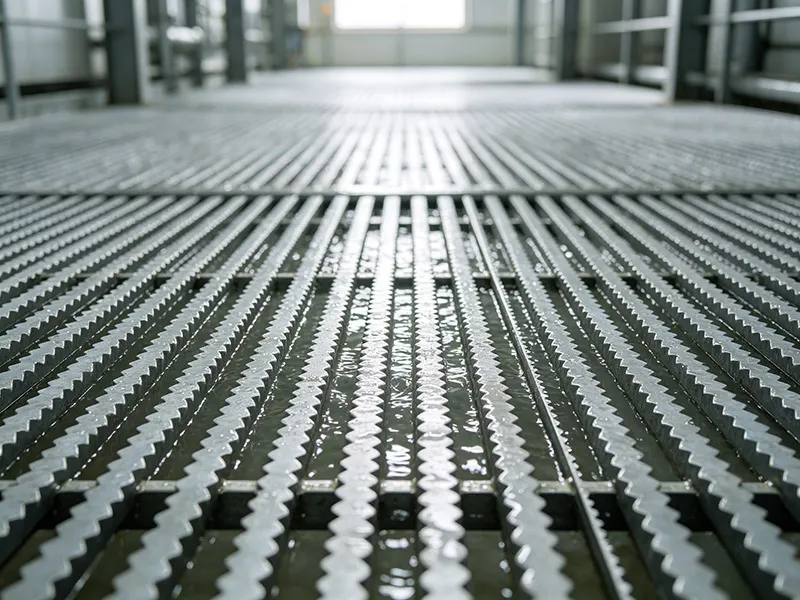
Serrated press-locked grating integrates mechanical interlock structure and anti-slip performance. Precision serrated friction teeth are machined on the surface of bearing bars, effectively increasing surface friction coefficient. It prevents slipping in wet, rainy, and slightly oily environments, retaining the flat and neat aesthetic advantages of press-locked grating while improving pedestrian safety, ideal for outdoor walkways and humid commercial spaces.
Micro-Square Dense Mesh Press-Locked Grating
This upgraded dense-grid press-locked grating adopts ultra-fine precise spacing design, achieving anti-falling and anti-clogging functions on the premise of retaining flat appearance. It is widely used for building facade ventilation grilles, municipal anti-drop trench covers, and public safety passages, meeting high-standard safety and aesthetic dual requirements.
Core Unique Advantages of Press-Locked Bar Grating
The non-welded mechanical cold-forming structure endows press-locked bar grating with irreplaceable comprehensive advantages, especially suitable for projects with high requirements for flatness, appearance uniformity, and precision.
Perfectly Flat Weld-Bump-Free Surface
Without welding process, there are no raised welding joints or thermal deformation protrusions on the grating surface. The full-plane flatness is far superior to welded grating, enabling flat laying without uneven gaps. It is very friendly for pedestrian walking, trolley passing, and architectural decoration paving, with neat and uniform overall visual effect.
Zero Thermal Deformation & Stable Material Properties
The whole cold-press forming process produces no welding high temperature, avoiding material structural changes and local stress concentration caused by thermal processing. The physical properties of each part of the steel bar remain consistent, effectively preventing local warping and deformation during long-term use, with higher overall structural stability.
High Grid Precision & Architectural Aesthetic Value
Hydraulic precision locking ensures consistent grid aperture and uniform spacing error within ultra-small range. The regular and orderly open-grid structure has excellent decorative and ornamental value, which can perfectly match modern architectural style. It is the preferred open-grid material for building exterior walls, landscape passages, and commercial space decoration.
Excellent Self-Cleaning & Functional Balance
The smooth flat surface and standard open-grid design avoid dust and silt accumulation. Rainwater and daily flushing can quickly wash away surface dirt, realizing natural self-cleaning. It balances high ventilation, light transmission, and rapid drainage functions, adapting to various environmental functional needs.
Lightweight & Easy Installation
Press-locked bar grating has an optimized lightweight structure with high strength-to-weight ratio. The flat panel is easy to cut, splice, and install on-site, with low construction difficulty and short project cycle. It requires no complicated post-welding correction, greatly improving engineering efficiency.
Wide Applications of Press-Locked Bar Grating
Relying on aesthetic advantages, precise structure, and reliable light-to-medium load performance, press-locked bar grating is widely used in architectural decoration, municipal landscape, commercial facilities, and light industrial scenarios.
Architectural & Commercial Decoration Projects
Press-locked bar grating is commonly used for building facade ventilation grilles, mall interior walkway flooring, sightseeing corridor passages, and exhibition hall decorative grid structures. Its flat and neat appearance improves overall building texture, while open-grid ventilation ensures indoor air circulation, achieving perfect integration of beauty and practicality.
Municipal Landscape & Public Infrastructure
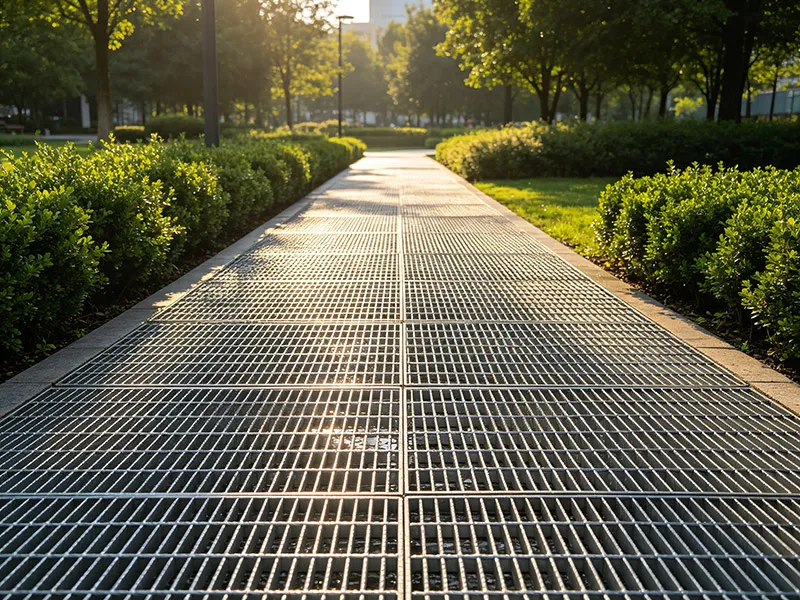
Urban park pedestrian paths, community landscape walkways, municipal sidewalk ventilation flooring, and anti-clog drainage trench covers all adopt press-locked bar grating. It meets urban public facility safety standards with flat and smooth walking surface, and its orderly grid design fits modern urban landscape planning.
Light-Duty Industrial & Clean Facility Scenarios
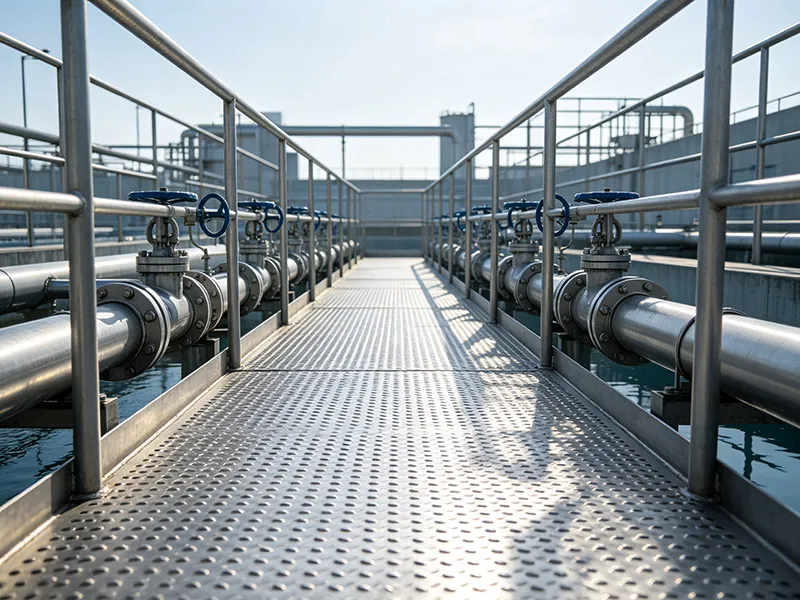
Light-duty factory maintenance platforms, workshop ventilation flooring, pharmaceutical clean rooms, and food processing workshops prefer press-locked bar grating. Its zero welding gap, smooth surface, and easy cleaning features meet high hygiene requirements, and stable mechanical interlock structure ensures long-term safe operation of light industrial platforms.
Marine & Yacht Decorative Facilities
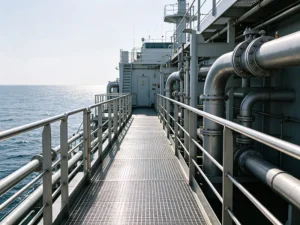
Luxury yacht deck passages, small ship sightseeing platforms, and port landscape corridors adopt stainless steel press-locked bar grating. The anti-corrosion material adapts to marine humid and salt fog environment, and the flat and delicate grid structure improves marine facility grade.
Press-Locked Bar Grating vs Other Grating Types
Clear professional comparison helps B2B buyers accurately distinguish product differences and select targeted grating according to project load standards and aesthetic requirements.
Press-Locked Bar Grating vs Welded Grating
Welded grating forms joints through thermal fusion welding, with inevitable welding bumps and slight thermal deformation on the surface. It has higher load-bearing capacity and is suitable for heavy-duty industrial scenarios. In contrast, press-locked bar grating adopts pure mechanical locking with completely flat surface and higher dimensional accuracy. Though its load capacity is slightly lower than welded grating, it excels in appearance flatness and overall uniformity, more suitable for aesthetic and light-to-medium load projects.
Press-Locked Bar Grating vs Forge Welded Grating
Forge welded grating relies on electro-forge metallurgical fusion, with ultra-high joint strength and strong vibration resistance, specially designed for heavy-load industrial and marine harsh environments. Press-locked bar grating uses mechanical interlock structure, with relatively lower extreme load resistance but far superior surface flatness and aesthetic performance. It is more suitable for architectural decoration and municipal landscape rather than heavy industrial bearing scenarios.
Press-Locked Bar Grating vs Weld-Lok Grating
Weld-Lok grating features reinforced welded locking joints with strong structural stability, focusing on industrial anti-vibration and heavy-load performance. Press-locked bar grating has no welding structure, with smoother surface and more uniform grid. It prioritizes precision and beauty, while Weld-Lok grating prioritizes structural strength and durability, forming a clear application differentiation.
Professional Selection & Maintenance Guide
Scientific specification selection and daily maintenance can maximize the service life and comprehensive performance of press-locked bar grating.
Material Selection: Conventional municipal landscape and indoor light industrial projects choose economical hot-dip galvanized press-locked bar grating. Coastal salt fog, chemical humidity, and high-hygiene clean room scenarios select 304/316 stainless steel models. Outdoor rainy and wet passages prioritize serrated anti-slip types.
Load Grade Selection: Pure pedestrian walkways and decorative ventilation facilities adopt standard light-duty press-locked grating. Slightly loaded light equipment platforms need to select thickened heavy-spec grating to ensure sufficient safety margin.
Grid Specification Selection: Public anti-drop safety passages choose dense mesh press-locked grating. Conventional ventilation and drainage scenarios adopt standard grid spacing to balance beauty and functional efficiency.
Daily Maintenance Tips: Press-locked bar grating has low maintenance cost. Regularly clean surface dust and grid gap debris to keep ventilation and drainage unobstructed. Check the mechanical interlock position regularly to ensure tight locking. Avoid long-term overload pressure to maintain long-term structural stability.
Conclusion
Press-Locked Bar Grating is a high-precision, high-aesthetic open-grid steel grating defined by pure mechanical hydraulic interlock forming technology. Different from thermally processed welded industrial grating, it features zero welding bumps, zero thermal deformation, ultra-flat surface, and uniform grid precision, filling the market gap of high-standard decorative and light-duty industrial grating.
With reliable light-to-medium load performance, excellent self-cleaning ventilation, diverse material options, and superior architectural ornamental value, press-locked bar grating is widely recognized in municipal landscape, architectural decoration, clean industrial, and marine light-duty projects. For global B2B purchasers focusing on project beauty, precision and long-term stable use, high-quality press-locked bar grating is an ideal cost-effective open-grid flooring solution.